
Packaging Guide · 3-Ply vs 5-Ply vs 7-Ply · International Courier
5-Ply vs 3-Ply Corrugated Boxes: How to Pack Your Parcel for International Courier from India
When an international parcel arrives crushed, soaked, or held together with a customs officer's re-tape job, most people blame the courier. But pull apart almost any "damaged in transit" complaint and the real story is usually the box — a single-wall carton that was never built to survive a journey through sorting belts, cargo holds, transit hubs, and customs scanners over several days.
The fix isn't expensive or complicated. It comes down to two things: choosing the right ply — the number of paper layers that make up your box's walls — and sealing and labelling it the way freight-grade parcels are packed. This guide breaks down 3-ply, 5-ply and 7-ply corrugated boxes, what GSM and burst strength actually mean, and exactly how ShipHit packs every parcel headed abroad from India.

Export & Logistics Specialist, ShipHit
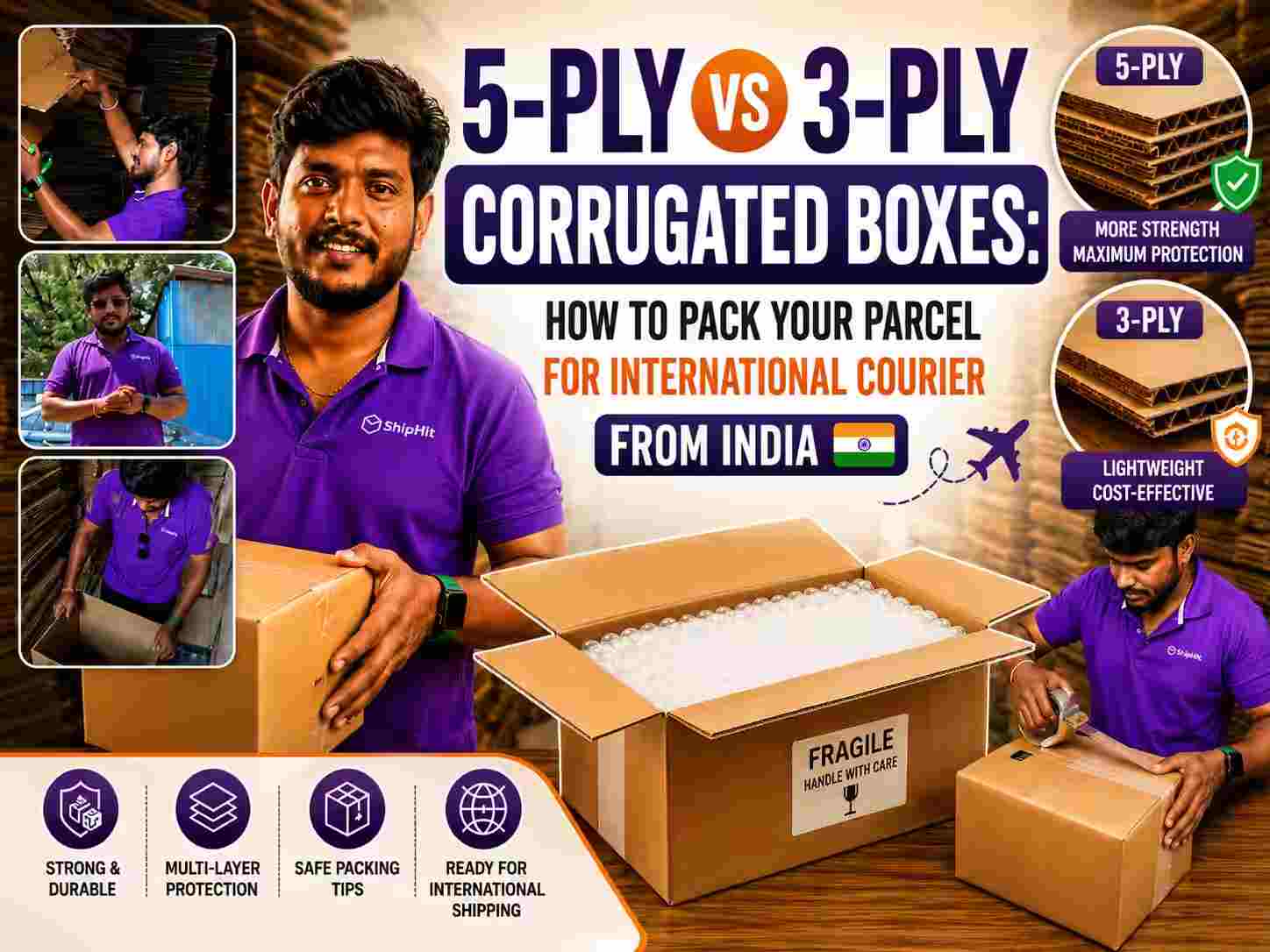

Table of Contents
- Why International Courier Damage Is (Almost Always) a Box Problem
- What Does "Ply" Actually Mean? 3-Ply vs 5-Ply vs 7-Ply Explained
- 3-Ply vs 5-Ply vs 7-Ply: Side-by-Side Comparison
- GSM and Burst Strength: The Specs That Decide If a Box Survives
- Which Box Should You Use? A Quick Decision Guide
- 7 Packaging Mistakes That Get International Parcels Damaged
- How ShipHit Packs Every International Parcel
- Box Size, Weight & Your Shipping Cost
- Frequently Asked Questions
- Ready to Ship? Get the Right Box & Packing from ShipHit
The Real Problem
Why International Courier Damage Is (Almost Always) a Box Problem
An international parcel from India doesn't take one smooth ride to its destination. It gets handled at a local hub, palletised for air freight, stacked under other boxes, scanned and sometimes opened at customs, transferred to a destination carrier, and finally driven out for doorstep delivery. Every one of those steps puts pressure, weight, or a knock on the box — and a thin, single-wall carton simply isn't built to absorb all of it.
In ShipHit's experience packing thousands of international parcels, the overwhelming majority of "damaged on arrival" cases trace back to weak outer packaging — not rough handling during the journey itself. Get the box right, and most damage risk disappears before the parcel even leaves the warehouse.
Here's what a weak box typically leads to on a long-haul route, such as ShipHit's courier service to the USA or sending a parcel to the UK:
- ✓Box collapse — when other parcels are stacked on top during cargo handling, single-wall boxes flatten or buckle
- ✓Punctured corners — sharp items inside push through thin walls, especially at corners and edges
- ✓Moisture damage — humidity during multi-day transit softens cheap, low-GSM cardboard until it loses rigidity
- ✓Failed re-seals — when customs opens a parcel for inspection, a flimsy box and weak tape rarely go back together cleanly
The good news: every one of these is preventable with the right combination of box ply, strength rating, and sealing method — which is exactly what the rest of this guide covers.
The Basics
What Does "Ply" Actually Mean? 3-Ply vs 5-Ply vs 7-Ply Explained
A corrugated box isn't just "cardboard" — it's an engineered sandwich of flat paper sheets (called liners) glued on either side of a wavy, fluted paper layer (called the medium). That wavy middle layer is what gives the board its strength and cushioning, the same way corrugated metal roofing is stronger than a flat sheet of the same material.
"Ply" simply counts how many of these layers — liners and flutes — are stacked together. More layers means more flutes absorbing impact, and more liners resisting crushing.
3-Ply
Single Wall · 3 layers · ~3-4 mm
Capacity: Up to ~3 KG
Documents, books, light clothing
5-Ply
Double Wall · 5 layers · ~6-7 mm
Capacity: ~3-20 KG
Most international parcels
7-Ply
Triple Wall · 7 layers · ~10-12 mm
Capacity: 20 KG and above
Heavy, bulky or high-value cargo
ℹ️A quick way to picture it: a 3-ply box is one corrugated sandwich (2 liners + 1 flute). A 5-ply box is two sandwiches glued together (3 liners + 2 flutes) — which is why it's also called double-wall. A 7-ply box is three sandwiches, or triple-wall.
Comparison
3-Ply vs 5-Ply vs 7-Ply: Side-by-Side Comparison
Here's how the three common box constructions stack up for international shipping from India:
| Box Type | Layers | Wall Thickness | Weight Capacity | Best For |
|---|---|---|---|---|
| 3-Ply (Single Wall) | 2 liners + 1 flute | ~3-4 mm | Up to ~3 KG | Documents, books, soft goods, gifts that travel inside another box |
| 5-Ply (Double Wall) | 3 liners + 2 flutes | ~6-7 mm | ~3-20 KG | General international parcels — sweets, handicrafts, kitchenware, clothing bundles, electronics |
| 7-Ply (Triple Wall) | 4 liners + 3 flutes | ~10-12 mm | 20 KG and above | Heavy or bulky cargo — furniture parts, idols, paintings, machinery components |
Most courier damage complaints come from items shipped in 3-ply boxes that should have been in 5-ply. The price difference between the two is small — usually a fraction of the total shipping cost — but the difference in crush resistance is significant, often close to double.
The Numbers
GSM and Burst Strength: The Specs That Decide If a Box Survives
Ply tells you how many layers a box has. But two 5-ply boxes can still perform very differently depending on the quality of the paper used. Two numbers tell you the real story:
GSM (Grams per Square Metre)
Measures how heavy/dense the liner paper is. Higher GSM means a thicker, stiffer liner that resists punctures and tears. Look for liners around 150-200 GSM or higher for international parcels.
ECT (Edge Crush Test)
Measures how much force the box's edges can take before crumpling — directly related to how much weight can be safely stacked on top of your parcel. Aim for ECT 20 kg/cm or higher on 5-ply boxes.
There's also the Burst Strength Test (BST), which measures the pressure a box wall can take before bursting — relevant if your parcel might get squeezed from the side rather than stacked from above.
💡You don't need to memorise these numbers as a customer — but knowing they exist helps when sourcing boxes locally. A box that "looks" like 5-ply but uses thin, low-GSM liners will still crush easily. ShipHit sources boxes that meet minimum GSM and ECT thresholds for every weight category before they're used for parcels travelling to Canada and other long-haul routes.
Decision Guide
Which Box Should You Use? A Quick Decision Guide
Match your shipment to one of these categories. When in doubt, go one tier stronger — the extra cost is small compared to a damaged or returned parcel.
Documents & Light Items (under 3 KG)
Certificates, books, stationery, light clothing, soft toys
Recommended: 3-ply (single wall) is acceptable, ideally inside a courier-grade flyer or rigid mailer
General Parcels (3-20 KG)
Sweets, snacks, pickles, kitchen items, sarees, toys, mixed gift hampers
Recommended: 5-ply (double wall) — the standard for most international courier shipments
Fragile or High-Value Items
Electronics, idols, paintings, glass or ceramic decor, musical instruments
Recommended: 5-ply box plus internal cushioning, often with a second outer box (double-boxing)
Heavy or Bulky Cargo (20 KG+)
Furniture pieces, large wooden items, bulk wedding-gift consignments
Recommended: 7-ply (triple wall) or a wooden crate, depending on shape and weight
Avoid These
7 Packaging Mistakes That Get International Parcels Damaged
Reusing an old box that's already been crushed once
A box loses most of its strength the first time it's compressed. Use a fresh box for international shipments — even if the old one looks fine on the outside.
Sealing with thin cellophane or single-strip tape
Use proper packing tape (BOPP, 2 inches wide) and apply the H-taping method — sealing the centre seam and both end flaps in an H-shape on top and bottom.
Leaving empty space inside the box
Empty space lets contents shift and the box flex under pressure. Fill gaps with crumpled paper, air pillows, or thermocol so nothing moves.
Putting a heavy item in a 3-ply box
A 3-ply box rated for ~3 KG will bow and split under 8-10 KG of weight, even if it technically 'closes'. Match the box ply to the actual weight.
Skipping Fragile / This Side Up labels
These labels visually signal handlers to be careful and avoid stacking heavy items on top — a small step that reduces handling damage significantly.
Wrapping items directly against the inner box wall
Even a strong box transmits shocks to its contents. Add a layer of bubble wrap or foam between the item and the box wall, especially at corners.
Ignoring liquid or odd-shaped items (jars, bottles, statues)
Wrap liquid containers individually, seal lids with tape, and place upright with cushioning on all sides — not just top and bottom.
ShipHit Standard
How ShipHit Packs Every International Parcel
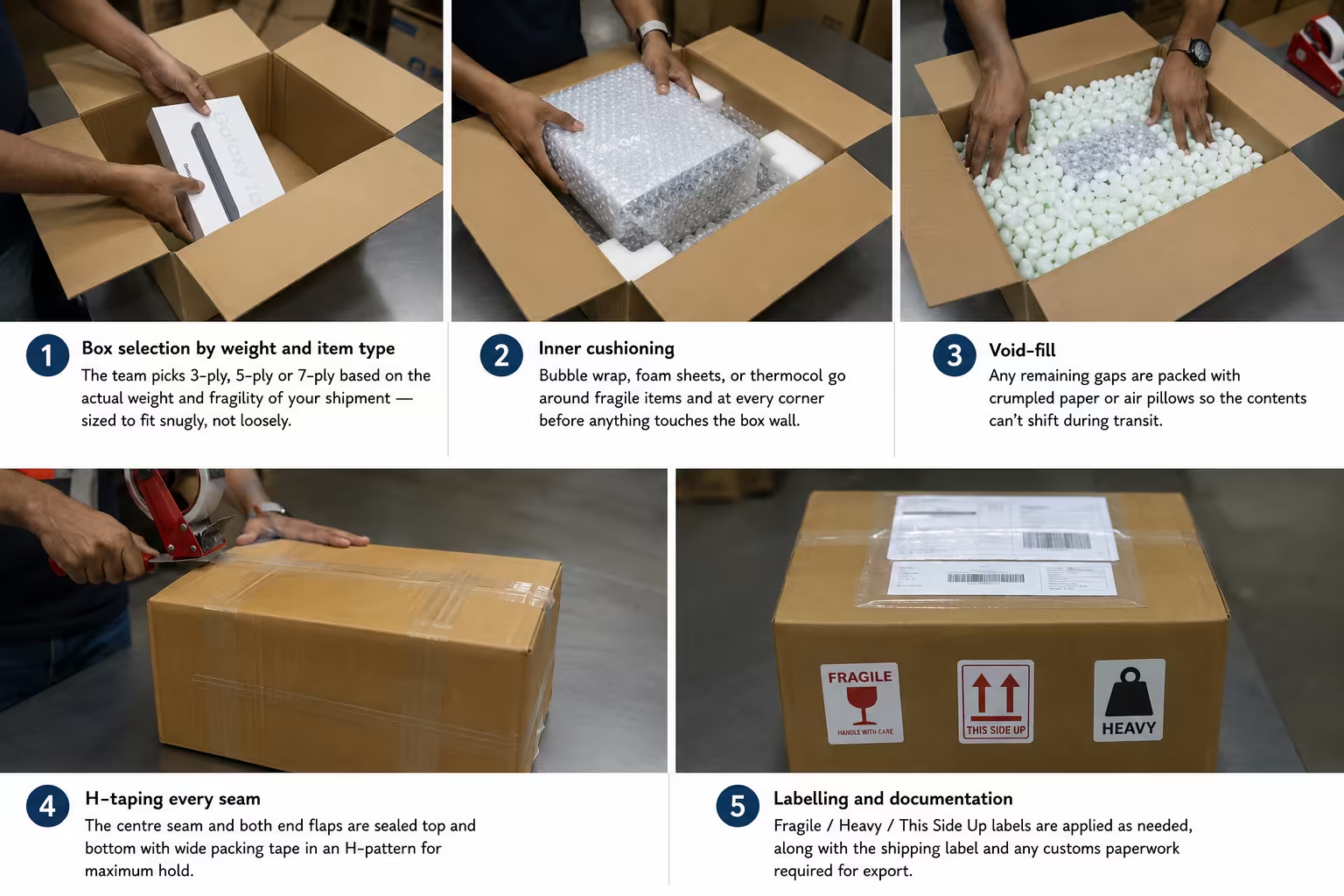
This is the same packing process applied to parcels heading to Dubai and the wider UAE, door-to-door delivery in Australia, and 220+ other countries — adjusted up in box strength for heavier or fragile items:
Box selection by weight and item type
The team picks 3-ply, 5-ply or 7-ply based on the actual weight and fragility of your shipment — sized to fit snugly, not loosely.
Inner cushioning
Bubble wrap, foam sheets, or thermocol go around fragile items and at every corner before anything touches the box wall.
Void-fill
Any remaining gaps are packed with crumpled paper or air pillows so the contents can't shift during transit.
H-taping every seam
The centre seam and both end flaps are sealed top and bottom with wide packing tape in an H-pattern for maximum hold.
Labelling and documentation
Fragile / Heavy / This Side Up labels are applied as needed, along with the shipping label and any customs paperwork required for export.
Cost Impact
Box Size, Weight & Your Shipping Cost
International couriers charge based on whichever is higher: the actual weight of your parcel, or its volumetric (dimensional) weight, calculated as Length × Width × Height ÷ 5000 (in cm). A box that's larger than it needs to be doesn't just cost more in packaging — it can push your shipment into a higher-priced weight bracket entirely.
Example: Same 4 KG Parcel, Two Box Sizes
Right-sized 5-ply box
30 × 25 × 20 cm
Volumetric weight ≈ 3 KG → billed on actual weight (4 KG)
Oversized box
45 × 35 × 30 cm
Volumetric weight ≈ 9.5 KG → billed on volumetric weight (9.5 KG)
💡A snug 5-ply box almost always beats an oversized 3-ply box on both protection and price. ShipHit calculates actual vs. volumetric weight before quoting, so you can see exactly how box size affects your final cost.
FAQ
Frequently Asked Questions
What is a 5-ply corrugated box and why does it matter for international courier?
A 5-ply (double-wall) box has 3 paper liners and 2 fluted layers, giving roughly double the crush resistance of a standard 3-ply box. For international courier — where parcels are stacked, sorted and handled multiple times across days — that extra strength is often the difference between a box arriving intact and one that collapses.
Is a 3-ply box strong enough for international shipping?
A 3-ply (single-wall) box is fine for light, low-risk items under roughly 2-3 KG, such as documents, books, or soft goods like clothing. For most international parcels — gifts, snacks, handicrafts, electronics, or anything above 3-5 KG — a 5-ply double-wall box is the safer minimum.
What GSM and ECT rating should I look for in a shipping box?
For international parcels, look for liners rated 150-200 GSM or higher with an Edge Crush Test (ECT) of at least 20 kg/cm for 5-ply boxes. Higher GSM and ECT values mean the box resists crushing under stacked weight during long-haul transit and warehouse storage.
Does using a stronger box increase my international courier cost?
A 5-ply box adds only a small amount to the packaging cost, but it reduces the risk of damage claims and re-shipping. What affects your courier cost more is box size — oversized boxes increase volumetric weight. ShipHit recommends a box that is snug and strong, not just bigger.
Does ShipHit provide packaging for international shipments?
Yes. ShipHit selects the right ply and box size based on your item's weight and fragility, adds cushioning and void-fill, seals every seam with the H-taping method, and labels parcels Fragile / Heavy / This Side Up before dispatch — all included as part of the door-pickup service.
Get Started
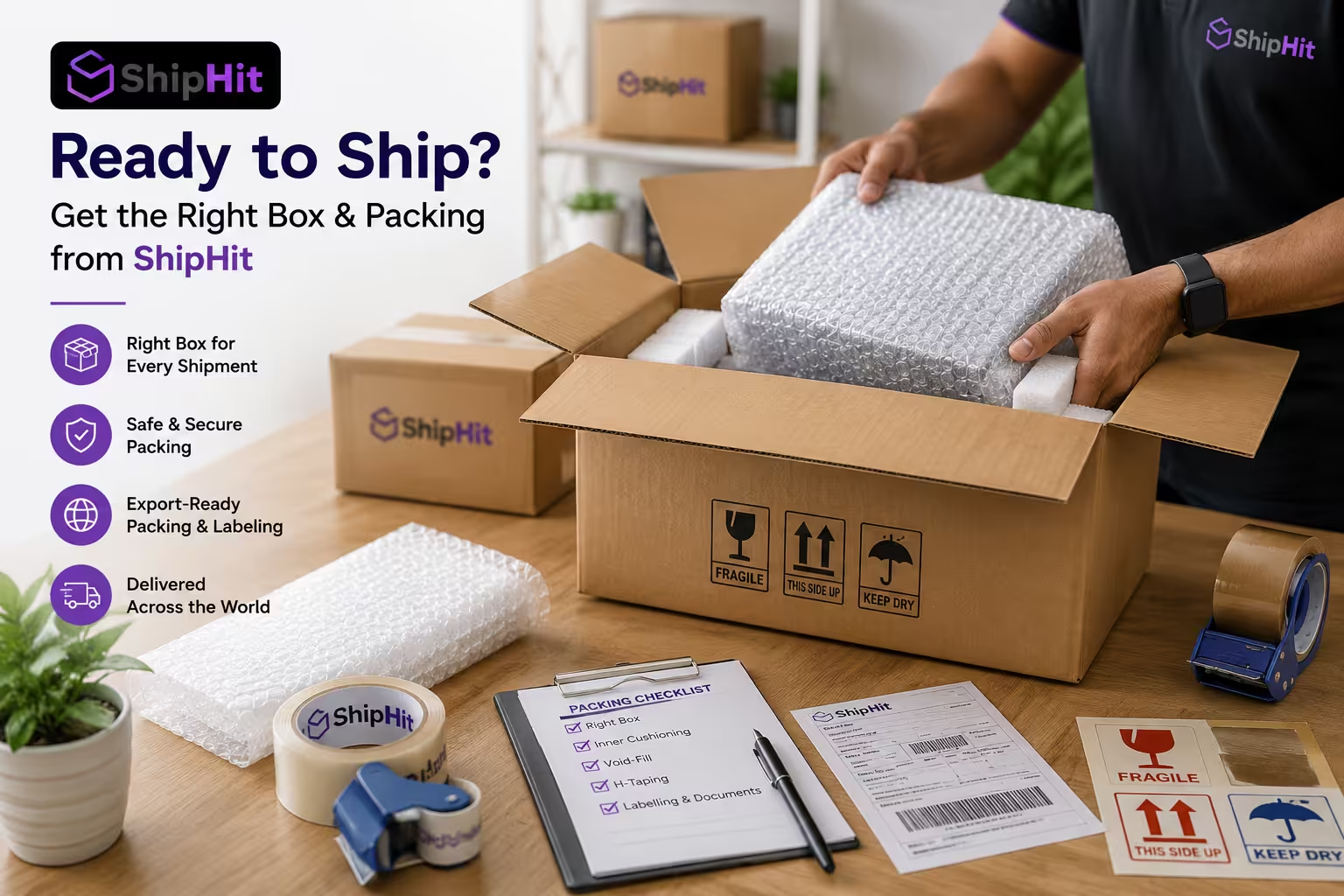
Ready to Ship? Get the Right Box & Packing from ShipHit
You don't need to source boxes, tape, or cushioning yourself. Book a pickup and ShipHit handles packaging end to end:
- ✅Box ply (3/5/7) selected based on your item's weight and fragility
- ✅Cushioning, void-fill and corner protection included
- ✅H-taping on every seam for a secure, customs-friendly seal
- ✅Fragile / Heavy / This Side Up labelling where needed
- ✅Volumetric vs. actual weight calculated before you're quoted
- ✅Door pickup across major Indian cities, 3-5 day express delivery to 220+ countries
ShipHit — Packed Right, Delivered Safely, Anywhere in the World.
ShipHit Blogs
International Shipping Guides, Customs Tips, Courier Updates, Packaging Advice, and Global Delivery Insights.

International Courier for Golu Dolls & Navratri Bommai | Shipping from India Worldwide
Golu bommai packing and shipping without a single chip - export packing for fragile clay and papier-mache, customs and duty, volumetric pricing, insurance, transit times to the six busiest destinations, and when to book before Navaratri.

International Express Shipping | The Perfect Balance of Speed and Security
What 'speed' and 'security' actually mean in international express shipping, and how to choose an express courier that never has to trade one for the other.
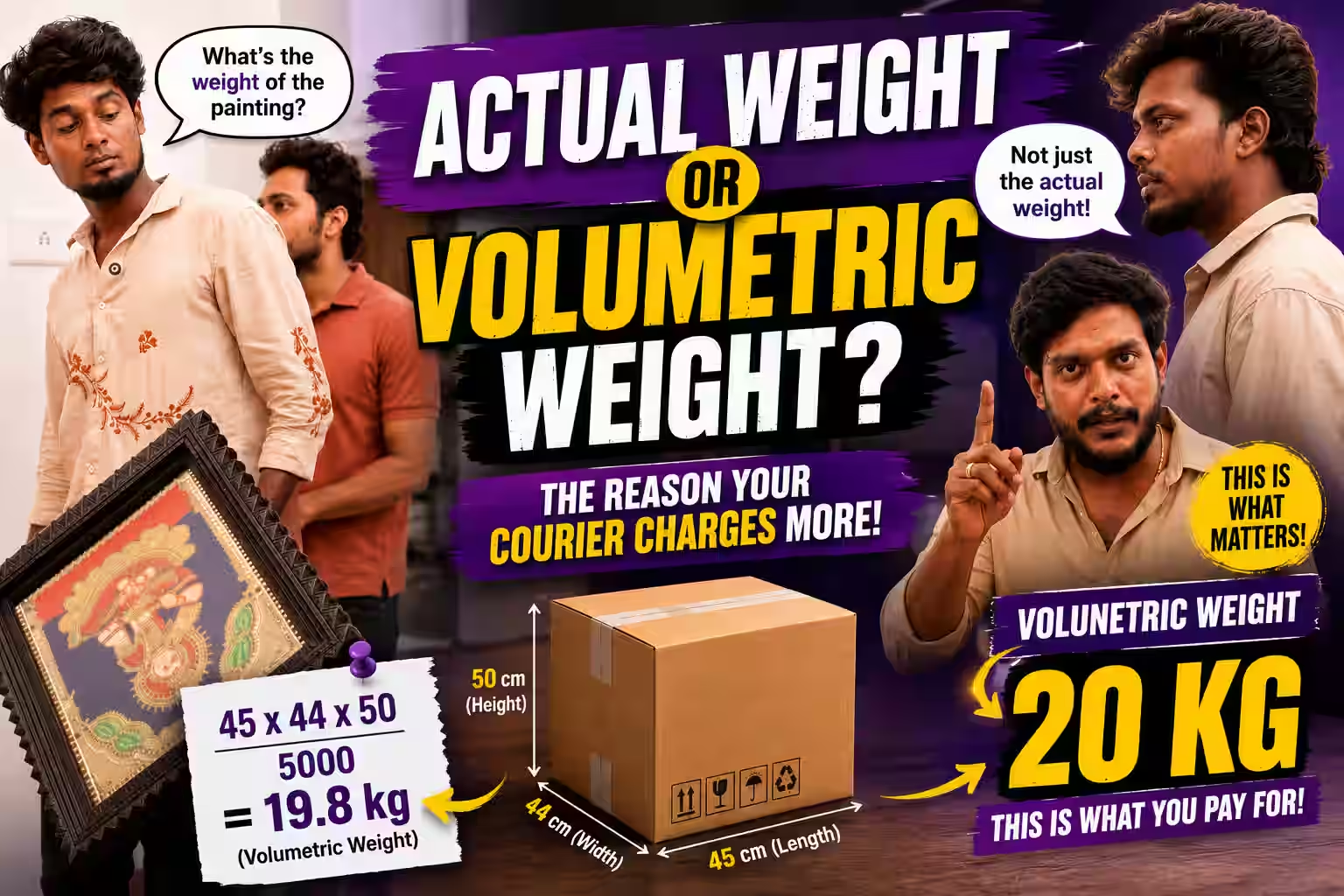
Actual Weight vs Volumetric Weight | The Complete Guide to International Courier Pricing
Why your courier bill is sometimes higher than the number on the scale - the volumetric weight formula, worked examples, and how to pack smarter to reduce chargeable weight.

