
Pricing Guide Courier · Courier Mode · Door Pickup · Customs Guidance
Actual Weight vs Volumetric Weight: How International Courier Charges Are Calculated in India
If you've ever opened a courier invoice and wondered why the final charge is higher than what the bathroom scale showed, the answer almost always comes down to one thing: volumetric weight. This guide breaks down exactly how actual weight and volumetric weight work together to set your international courier price - with the full formula, worked examples, and practical packing tips to keep the charge as low as possible.

Export & Logistics Specialist, ShipHit
Formula
L x W x H / 5000
Volumetric weight in kilograms, using centimetre dimensions and the international air freight divisor.
Chargeable Weight
Higher of the Two
Couriers always bill whichever is greater - actual scale weight or calculated volumetric weight.
Industry Standard
DHL, FedEx, Aramex, UPS
The 5000 divisor is used consistently across major international air-courier networks, including ShipHit.
Packing Savings
20-30% Possible
Compressing soft items and choosing a tighter box size can meaningfully cut dimensional weight.


Table of Contents
- What is actual weight?
- What is volumetric (dimensional) weight?
- Worked example: how the formula plays out
- Actual weight vs volumetric weight - side-by-side comparison
- More worked examples by common parcel type
- 4 ways to reduce your volumetric weight (and your bill)
- How ShipHit keeps volumetric weight pricing transparent
- How to book your ShipHit pickup
What is actual weight?
Actual weight is the simplest number in the equation: the real mass of your parcel on a scale.
Actual weight is exactly what it sounds like - the number you get when you place your parcel on a scale, measured in kilograms. A 3 kg box of clothes weighs 3 kg, full stop. For decades this was the only number couriers used to calculate a price. But as air cargo space became the real bottleneck in international shipping, not just weight, the industry needed a second, fairer metric to price shipments accurately.
ShipHit's short explainer video walks through exactly how this works, and you can watch ShipHit's actual vs volumetric weight video alongside this article for a quick visual summary of the formula.
What is volumetric (dimensional) weight?
Volumetric weight estimates how much space your parcel occupies in an aircraft cargo hold, then converts that space into an equivalent weight.
The logic is straightforward: a large, lightweight box - like a bundle of clothes or a bulky toy - takes up the same physical space as a heavy, dense box, even though it weighs far less. Airlines and courier networks charge for space because space, not just weight, is what's limited on every flight. This is why a parcel that feels light in your hands can still attract a higher bill once its dimensions are factored in.
The volumetric weight formula
Volumetric weight (kg) = Length (cm) x Width (cm) x Height (cm), divided by 5000. This 5000 divisor is the international air freight industry standard, used consistently by DHL, FedEx, Aramex, UPS, and ShipHit. Some domestic or surface/sea shipments use a different divisor, such as 6000 - always check which mode applies to your shipment.
Worked example: how the formula plays out
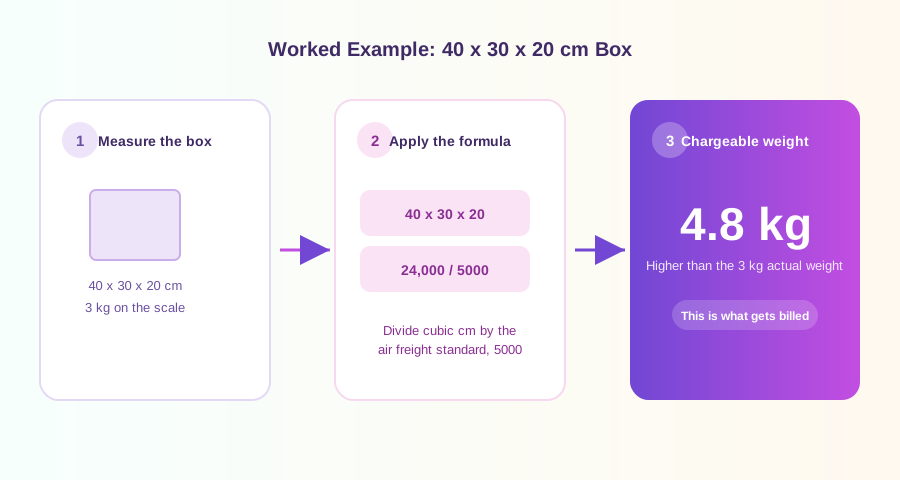
A parcel can weigh very little on the scale but still be billed at a much higher weight once its box size is factored in.
Say you're sending a box measuring 40 cm x 30 cm x 20 cm, and it weighs 3 kg on the scale. Even though the box only weighs 3 kg, you pay for 4.8 kg. This single rule explains the majority of 'surprise' courier bills - and it's exactly why ShipHit's pickup executive calculates both numbers in front of the customer before confirming a final charge, instead of adjusting it later.
- Actual weight: 3 kg, measured directly on the scale.
- Volumetric weight: 40 x 30 x 20 divided by 5000 equals 4.8 kg.
- Chargeable weight: 4.8 kg, because the courier always bills the higher of the two figures.
Actual weight vs volumetric weight - side-by-side comparison
Dense, tightly packed items are usually billed on actual weight, while bulky, loosely packed items are billed on volumetric weight.
Notice the pattern in the comparison below: what a courier measures, how each figure is calculated, and which type of parcel typically triggers each outcome. Understanding this pattern is the single most useful thing to know before you pack a box for international shipping.
| Factor | Actual Weight | Volumetric Weight |
|---|---|---|
| What it measures | Physical mass on a scale | Space occupied by the parcel's dimensions |
| Formula | Direct scale reading (kg) | L x W x H (cm) divided by 5000 |
| Best case for customer | Small, dense, heavy items (books, spices, metal parts) | N/A - always compared against actual weight |
| Worst case for customer | N/A | Large, lightweight, loosely packed items (clothes, soft toys, oversized boxes) |
| Who charges this way | All couriers, as the baseline | DHL, FedEx, Aramex, UPS, ShipHit - industry standard for air shipments |
Whichever number is higher becomes the chargeable weight on your invoice.
More worked examples by common parcel type
The same box size can be billed on actual weight or volumetric weight depending entirely on what's packed inside it.
These four examples show how identical-looking boxes can be billed very differently depending on density. Dense food boxes and compact electronics tend to bill on actual weight, while clothing and even lightweight document envelopes can tip over into volumetric pricing.
| Parcel | Dimensions (cm) | Actual Weight | Volumetric Weight | Chargeable Weight |
|---|---|---|---|---|
| Dense food box (podi, dry sweets) | 25 x 20 x 15 | 4 kg | 1.5 kg | 4 kg (actual is higher) |
| Clothes / saree box | 50 x 40 x 30 | 4 kg | 12 kg | 12 kg (volumetric is higher) |
| Documents envelope | 35 x 25 x 3 | 0.5 kg | 0.53 kg | 0.53 kg (volumetric is higher) |
| Electronics (compact, dense) | 30 x 25 x 20 | 5 kg | 3 kg | 5 kg (actual is higher) |
4 ways to reduce your volumetric weight (and your bill)
Most of the savings in international courier pricing come from smarter packing, not from switching destinations.
It's tempting to see volumetric weight as a way for couriers to charge more, but the logic holds up: an aircraft cargo hold has a fixed volume, not a fixed weight limit. A plane can run out of physical space to load pallets long before it runs out of weight capacity. Charging by volume when a parcel is bulky - and by actual weight when it's dense - is how the entire international air logistics industry keeps flights economically viable while still offering fair, usage-based pricing.
- Pack compact, not loose. Oversized boxes with empty air space inflate your volumetric weight for no reason - choose the smallest box that safely fits your items.
- Compress soft items. Clothes, blankets, and soft toys compress significantly; vacuum bags or firm packing can shrink dimensions and cut volumetric weight by 20-30%.
- Consolidate shipments. Two separate boxes to the same address almost always cost more in combined volumetric weight than one well-packed box.
- Let a professional choose the box. A pickup executive who selects the right-sized box on-site and calculates both actual and volumetric weight transparently removes the guesswork before the final charge is confirmed.
How ShipHit keeps volumetric weight pricing transparent
The higher of the two figures becomes your chargeable weight, and that price is locked on your invoice with no additions after pickup.
This is the exact process demonstrated in ShipHit's actual vs volumetric weight video: an instant estimate to start, an on-site verification at your doorstep, and a final price that matches what you were quoted. Every major global carrier applies the same underlying principle, which is why volumetric weight isn't a ShipHit-specific charge - it's a global aviation cargo standard.
Customers consistently choose ShipHit's international courier service for predictable, transparent pricing built entirely around this same two-factor method.
| Step | What Happens |
|---|---|
| 1. Instant estimate | Enter approximate dimensions and weight for a real-time quote before you book. |
| 2. On-site verification | The pickup executive weighs the parcel and measures its dimensions at your doorstep, calculating both actual and volumetric weight in front of you. |
| 3. Final price lock | The higher of the two figures becomes your chargeable weight, and that price is locked on your invoice with no additions after pickup. |
How to book your ShipHit pickup
Getting an instant quote that already compares actual and volumetric weight takes just a few minutes.
Whichever option you choose, the price you see is the price on your final invoice - the same transparent chargeable-weight method explained throughout this guide applies to every booking.
Phone call: call 9159 688 688 to speak directly with the ShipHit team about your shipment.
Get an instant, accurate quote using ShipHit's online price calculator which automatically compares actual and volumetric weight for you.
Whatever you're packing, from documents to bulky clothing, browse everything ShipHit ships internationally to see category-specific packing and pricing guidance before you book.
- Online calculator (fastest): enter your parcel's weight and dimensions for an instant quote based on your parcel's chargeable weight.
- WhatsApp: send parcel details to 9159 688 688 for a quote within minutes.
Frequently Asked Questions
What is the difference between actual weight and volumetric weight?
Actual weight is the real weight of a parcel measured on a scale. Volumetric weight is a calculated weight based on the parcel's dimensions (length x width x height, divided by 5000 for air shipments), representing the space it occupies in cargo. Couriers charge based on whichever figure is higher.
How is volumetric weight calculated for international courier shipments?
Volumetric weight (kg) equals Length (cm) multiplied by Width (cm) multiplied by Height (cm), divided by 5000. This is the standard formula used by DHL, FedEx, Aramex, UPS, and ShipHit for international air shipments.
Why do couriers charge volumetric weight instead of just actual weight?
Aircraft cargo holds have limited physical space, not just limited weight capacity. A large, lightweight box takes up the same space as a heavy, dense one, so couriers charge for space using volumetric weight to keep pricing fair and flights economically viable.
What is chargeable weight in courier shipping?
Chargeable weight is the weight actually billed on your invoice - it is always the higher of actual weight and volumetric weight, whichever number is greater for your specific parcel.
How can I reduce volumetric weight when packing a parcel?
Pack items compactly in the smallest safe box, compress soft items like clothing, avoid excess empty space, and consolidate multiple items into a single shipment instead of separate boxes.
Does ShipHit use volumetric weight for pricing?
Yes. Like all major international couriers, ShipHit uses the industry-standard two-factor method, but calculates both actual and volumetric weight transparently at pickup, so the quoted price matches the final invoice with no hidden additions.