
International Courier for Bronze Idols: Ship Swamimalai Panchaloha Statues from India Worldwide

This guide explains how international courier from India moves bronze idols — the antiquity paperwork that decides whether a statue may legally leave the country, the dense metal weight that drives the cost, and the packing that protects a panchaloha casting.
Bronze is the rare shipment where breakage is not the main worry; a solid casting outlasts the carton around it. What stops these consignments is documentation, and almost every delay traces back to one question: how old is it?
First Question
Is It An Antiquity?
Anything over 100 years old is regulated under the Antiquities and Art Treasures Act, 1972.
Craft Origin
Swamimalai, Thanjavur
GI-tagged Chola-tradition bronzes cast by Sthapathy families.
Billing
Actual Weight Wins
Dense bronze bills on real weight, not volume.
Packing Risk
Patina And Projections
Not shattering — abrasion, bent attributes, a shifting idol.

Export & Logistics Specialist, ShipHit
Start here
What You Are Actually Shipping
How a bronze idol is made explains its value and the paperwork that follows it.
Most Tamil Nadu bronzes come from Swamimalai near Kumbakonam, where the Chola tradition has run unbroken since Rajaraja Chola I, and the craft carries a Geographical Indication tag. Sthapathy families cast them by madhuchchishta vidhana, the lost-wax method: a clay-coated wax model is melted out, metal poured in, the mould broken — so no two are identical.
Panchaloha icons, intended for worship, alloy five metals: copper, silver, gold, tin and lead or zinc. The alloy matters for your declaration, because a panchaloha idol is a religious article and a brass figurine a handicraft.
If your shipment mixes idols with lamps, bells and other temple articles, the broader rules are set out in our guide to international courier for god idols, statues and pooja items from India.
Compliance first
The Antiquity Rule That Decides Everything
Settle this before packing, weight or cost. It is the only issue that can stop a bronze idol leaving India.
The Antiquities and Art Treasures Act, 1972 regulates the export of antiquities. An object over 100 years old falls within its scope, and sculptures and icons are covered. Determination sits with the Archaeological Survey of India, and lawful export happens only under permit.
For almost everyone the consequence is different. Your idol is new — bought this year from a Swamimalai workshop — but made to look centuries old, because that is the point of the craft.
- Newly cast idol with an invoice — the ordinary case. Ships as a handicraft or religious article.
- Inherited or aged-looking piece — get it examined first. Age is a legal question, not an aesthetic one.
- Genuine antiquity — not a courier shipment at all. Permit requirements under the 1972 Act apply.
- Temple-origin items — require documented lawful provenance. Without it, do not attempt export.
With bronze, the paperwork question is not what it weighs. It is how old it is.
When a dated invoice is enough
For a bronze bought this year from a named workshop, a dated GST invoice is normally sufficient — it establishes declared value and recent manufacture at once, so it should travel outside the carton. Photographs before packing strengthen the point.
When to obtain an ASI non-antiquity certificate
Consider one whenever the piece could be mistaken for old: an antiqued finish, a temple-scale icon, or anything inherited. Allow time — far easier before packing than after.
Pricing
Weight and Cost: Why Bronze Behaves Unlike Every Other Handicraft
Most Indian handicrafts are light and bulky, so they bill on volume. Bronze inverts that completely.
Courier pricing takes whichever is greater: actual weight, or volumetric weight calculated as length × width × height ÷ 5000. Clay dolls, papier-mâché and textiles bill on volume. A solid bronze idol does not.
A twelve-inch Nataraja can weigh eight to twelve kilograms in very little space, so you pay on the metal. Bronze is one of the few categories where generous packing costs almost nothing.
| Piece | Typical weight | Bills on | Planning note |
|---|---|---|---|
| Small deity, 6–8 inch | 2–4 kg | Actual weight | Easiest first shipment |
| Nataraja, 12 inch | 8–12 kg | Actual weight | Projecting limbs need bracing |
| Seated deity with plinth, 15 inch | 12–20 kg | Actual weight | Plinth often ships separately |
| Large temple icon, 24 inch + | 30 kg + | Actual weight | Usually cargo, not parcel courier |
The calculation behind which figure applies to your carton is worked through in our guide to actual weight versus volumetric weight in international courier pricing.
The method
Packing a Bronze Casting Properly
The idol will survive. The risk is what a heavy object does to its carton — and what the carton does to its surface.
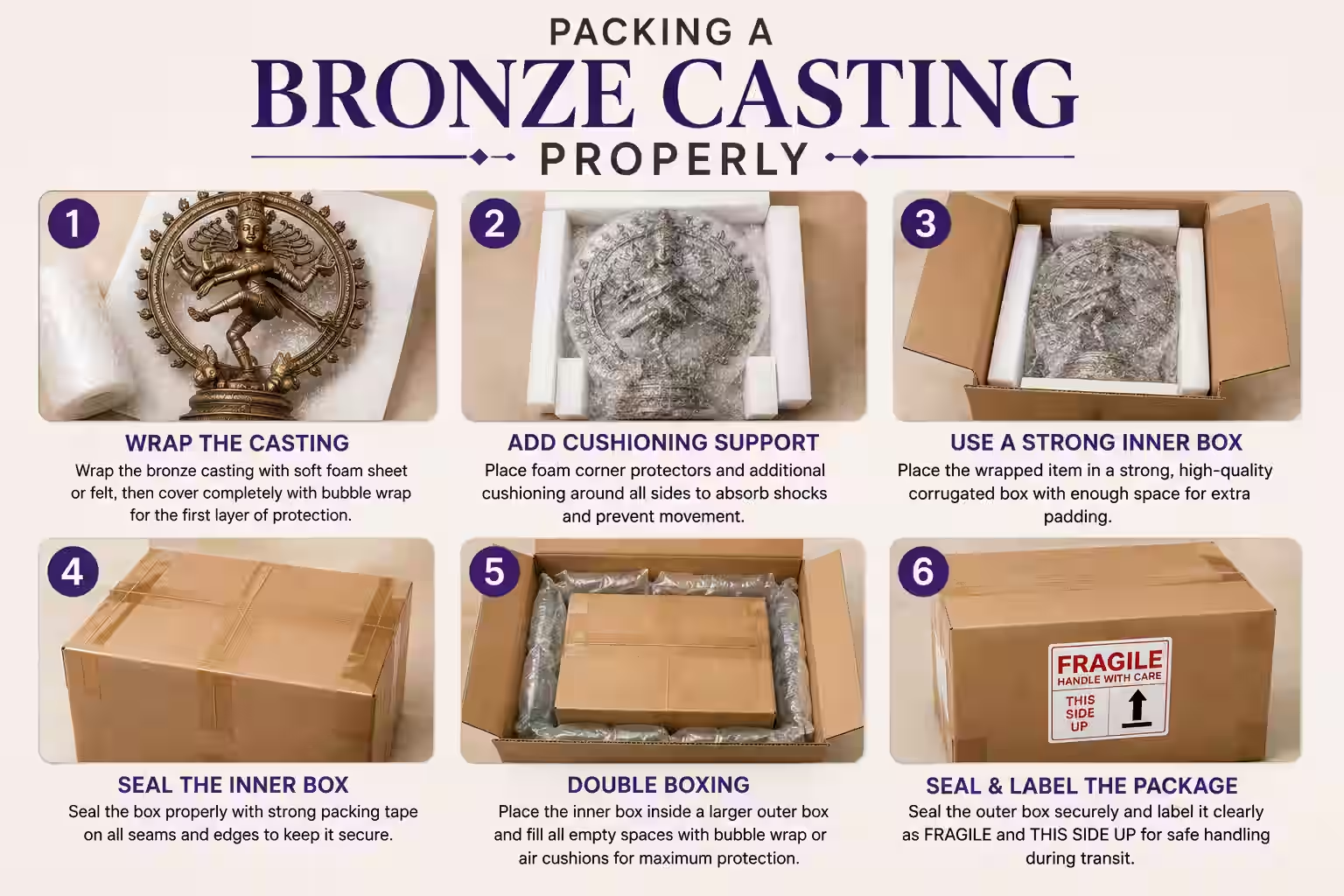
- Photograph the idol from every side before wrapping.
- Wrap the surface in acid-free tissue first; bubble wrap on a polished finish marks the patina.
- Brace every projection separately — raised arms, a trident, a prabhavali arch. These bend rather than break, and a bent attribute is harder to fix than a chip.
- Detach the plinth where the piece separates and wrap it as its own unit.
- Use a double-wall or 10-ply carton — 10 kg of metal punches through single-wall board.
- Immobilise with dense foam, not loose fill — a shifting idol wrecks its carton.
- Never use hay, straw or rice husk — organic filler is a biosecurity risk.
- Seal with H-pattern taping; keep the invoice and certificate accessible outside.
For a dense object the board grade is the single most important packing decision, explained in our comparison of 10-ply versus 5-ply corrugated boxes for international courier.
Country notes
Declaration, Duty and Destination Notes
Bronze idols are freely importable almost everywhere. What varies is duty and how closely age is questioned.
Describe the item precisely on the commercial invoice — 'new panchaloha religious idol' or 'new brass and bronze decorative statue' — with the workshop name, purchase date and honest value. Under-declaring voids your insurance.
| Destination | What to expect |
|---|---|
| USA | Routinely imported; duty on declared value. Antiquity claims attract scrutiny, so state it is newly made. |
| UK & Europe | Import VAT on declared value. Cultural-property checks apply to objects presented as antique. |
| Canada | Straightforward for new religious articles; duty and provincial tax on value. |
| Australia & New Zealand | Strict biosecurity on packing material, not the metal. Organic filler risks the consignment. |
| Singapore, Malaysia & UAE | Established routes; religious articles clear quickly with clean paperwork. |
Deity-specific handling, from Ganesha and Murugan to Nataraja castings, is covered route by route in our guide to shipping Hindu idols and religious statues from India to the USA and UK.
Protecting the shipment
Insurance and Proof of Value
Bronze rarely arrives damaged, but when it does the loss is large — which is when documentation earns its keep.
- Insure on declared value — kept consistent across invoice, declaration and insurance. A mismatch stalls claims.
- Keep the workshop invoice — with the GST number and date — it proves value and recent manufacture at once.
- Photograph before packing — including the base and maker's mark, so casting marks are not read as transit damage.
- Expect an occasional customs hold — on high-value religious articles. With clean paperwork it resolves.
Bronze often travels alongside stone and wooden pieces, and the mixed-material approach is set out in our guide to international courier for handicrafts, statues and artefacts from India.
Quick answers
Frequently Asked Questions
01Can I send bronze idols abroad by international courier from India?
Yes, provided the idol is not an antiquity. Newly cast bronze and panchaloha idols ship regularly as religious articles. Carry a dated GST invoice and pack in a double-wall carton.
02What is the antiquity rule for exporting bronze statues from India?
The Antiquities and Art Treasures Act, 1972 covers objects over 100 years old, including sculptures and icons. The Archaeological Survey of India determines status; export needs a permit.
03Do I need a non-antiquity certificate to ship a bronze idol?
Not for every shipment. A dated purchase invoice is usually enough. Where a bronze is antiqued, unusually large or inherited, an ASI certificate removes doubt.
04How much does it cost to ship a bronze idol to the USA?
Bronze bills on actual weight rather than volumetric weight, because the metal is dense. A twelve-inch Nataraja weighs eight to twelve kilograms.
05How should a panchaloha idol be packed for international courier?
Wrap the surface in acid-free tissue before any bubble wrap, brace every projecting limb separately, detach the plinth if it separates, and immobilise the piece in dense foam inside a 10-ply carton.
06Will my bronze idol attract customs duty at the destination?
Usually yes, assessed on declared value, with rates varying by country. Import VAT applies across the UK and Europe. Under-declaring voids insurance on an irreplaceable item.
Ship Your Bronze Idol With the Paperwork Settled First
Send us photographs and the purchase invoice before you pack. We will confirm what the destination expects, advise whether a non-antiquity certificate is worth obtaining, and pack the casting so it arrives as it left the workshop.
Talk to the team on WhatsApp at 9159 688 688, or once your documentation is ready we will schedule a doorstep pickup for your bronze consignment.
Swamimalai and Kumbakonam pieces usually route through our Chennai facility, where the international courier service in Chennai handles export packing for heavy metal artefacts.