
Handicraft Courier · Courier Mode · Door Pickup · Customs Guidance
International Courier for Sending Handicrafts, Statues and Artifacts Abroad: Materials, Antiquity Rules and Packing
Indian handicrafts are among the easiest things in the world to sell abroad and among the easiest to get stopped at a border. The reason is rarely the craftsmanship or the packing. It is that a handicraft is not judged as an object but as a set of materials and an age, and a piece can be perfectly legal to own, sell and display in India while being prohibited to export. This page covers the material rules and the antiquity rule that apply to every Indian craft export, then points to the guides for each specific craft.

Export & Logistics Specialist, ShipHit
Hard stop
Over 100 Years
An antiquity under the 1972 Act. Export is not permitted.
Banned outright
Ivory & Peacock
Peacock feather export is prohibited under EXIM policy.
The exception
Finished Sandalwood
Raw sandalwood cannot go. A finished carving can.
Clears the doubt
ASI Certificate
A non-antiquity certificate, issued before you pack.


Step 01
Four material families, four different problems
Almost every Indian craft falls into one of four groups, and each fails in its own way. Knowing which group you are holding tells you most of what you need.
Customs asks two questions about a handicraft — what is it made of, and how old is it — and the carrier asks a third: how will it behave in a hold. The material answers all three at once, which is why it is the right place to start rather than the price or the size.
| Family | Typical pieces | What it needs |
|---|---|---|
| Metal | Brass and bronze figures, panchaloha castings, copper vessels, Dhokra work | Heavy for its size, so it bills on real weight and concentrates load on corners. Surfaces tarnish and scratch; antiqued finishes invite antiquity questions. |
| Stone | Granite and marble sculpture, soapstone carving, marble inlay | The heaviest category and the most likely to need crating rather than a carton. Edges and protruding limbs chip first. |
| Wood | Rosewood and sandalwood carving, Channapatna toys, carved panels | The category with the most material restrictions, and the one where solid-wood packaging rules also apply. |
| Fragile mixed | Terracotta, ceramic, glass, papier mâché, resin, lacquer | Light and brittle. These are volumetric rather than heavy, and they fail from vibration and point pressure rather than impact. |
A single piece often spans two families — a brass figure on a marble base, or a wooden frame with glass. Pack for the more fragile of the two.
Step 02
The materials that stop a shipment outright
This is the section worth reading before you buy, not before you pack. Several of these are legal to own and sell in India and still cannot leave the country.
India protects certain species and materials under the Wildlife (Protection) Act, 1972 and its Foreign Trade Policy, and those protections apply to finished craft objects as much as to raw material. A shop selling the piece is not confirmation that it can be exported — the shopkeeper is trading domestically, which is a different question.
- **Ivory** — banned. India prohibits domestic ivory trade, ivory is CITES Appendix I, and import is prohibited into the USA, UK, EU and Australia. There is no route for an ivory-inlaid piece.
- **Peacock feathers** — export is prohibited under India's EXIM policy. The peacock is a Schedule I species, and while trade in naturally shed feathers is not itself an offence domestically, sending them abroad is a separate matter. This catches out a great many decorative and festival crafts.
- **Red sanders** (*Pterocarpus santalinus*) — CITES Appendix II and moved to Schedule IV of the Wildlife Protection Act in December 2022. Export is restricted rather than free, and the reddish carved pieces sold as souvenirs are exactly what the rule targets.
- **Sandalwood** — prohibited for export in any form **except** fully finished handicrafts and machine-finished sandalwood products. A finished carving can go; a raw block, offcuts, chips, powder or oil cannot.
- **Anything from a protected species** — tortoise and turtle shell, coral, certain animal bone and horn, and skins. Assume prohibited unless it is documented otherwise.
- Tell ShipHit the materials at the quoting stage. Every one of these is far easier to resolve before the piece is bought than after it has been collected.
The sandalwood distinction is the one people get wrong
Sandalwood is the most-asked-about craft material and the answer is genuinely encouraging, provided the piece is finished. A carved sandalwood figure, box or panel that is a completed handicraft is exportable. Raw sandalwood in any form — blocks, chips, dust, offcuts and oil — is not, regardless of quantity or how it is described. If a piece is part-finished, finish it before you ship it.
Step 03
The 100-year rule, and the certificate that settles it
The single hardest limit in craft export, and the one most often discovered after a buyer has already paid.
Under the **Antiquities and Art Treasures Act, 1972**, an object more than one hundred years old is an antiquity. Antiquities must be registered with the Archaeological Survey of India, and their export is not permitted for a private seller. Age is assessed on the object, not on when you acquired it or how it was described when you bought it.
Metal castings are where this comes up most, because a good antiqued bronze is convincing by design. We have set out when an invoice suffices and when a certificate is worth the wait in our guide to Bronze idols guide which covers the metal-specific detail.
- Anything genuinely over a century old cannot be exported. An inherited piece of uncertain age should be assessed before it is listed for sale, not after.
- A contemporary piece in traditional style is not an antiquity. Style has never been the test — age is.
- The grey area is deliberate ageing. An antiqued patina, a temple-scale icon or a deliberately weathered finish can all raise the question at a border even when the piece was made last year.
- For those cases, the ASI operates Expert Advisory Committees that issue **non-antiquity certificates** specifically so genuinely modern work can be exported without argument.
- Get the certificate before packing. It takes time, and obtaining one for a piece already sitting in a customs hold is far harder than obtaining it in advance.
- A dated maker's invoice with photographs is often sufficient on its own for an ordinary modern piece.
Step 04
Packing by material
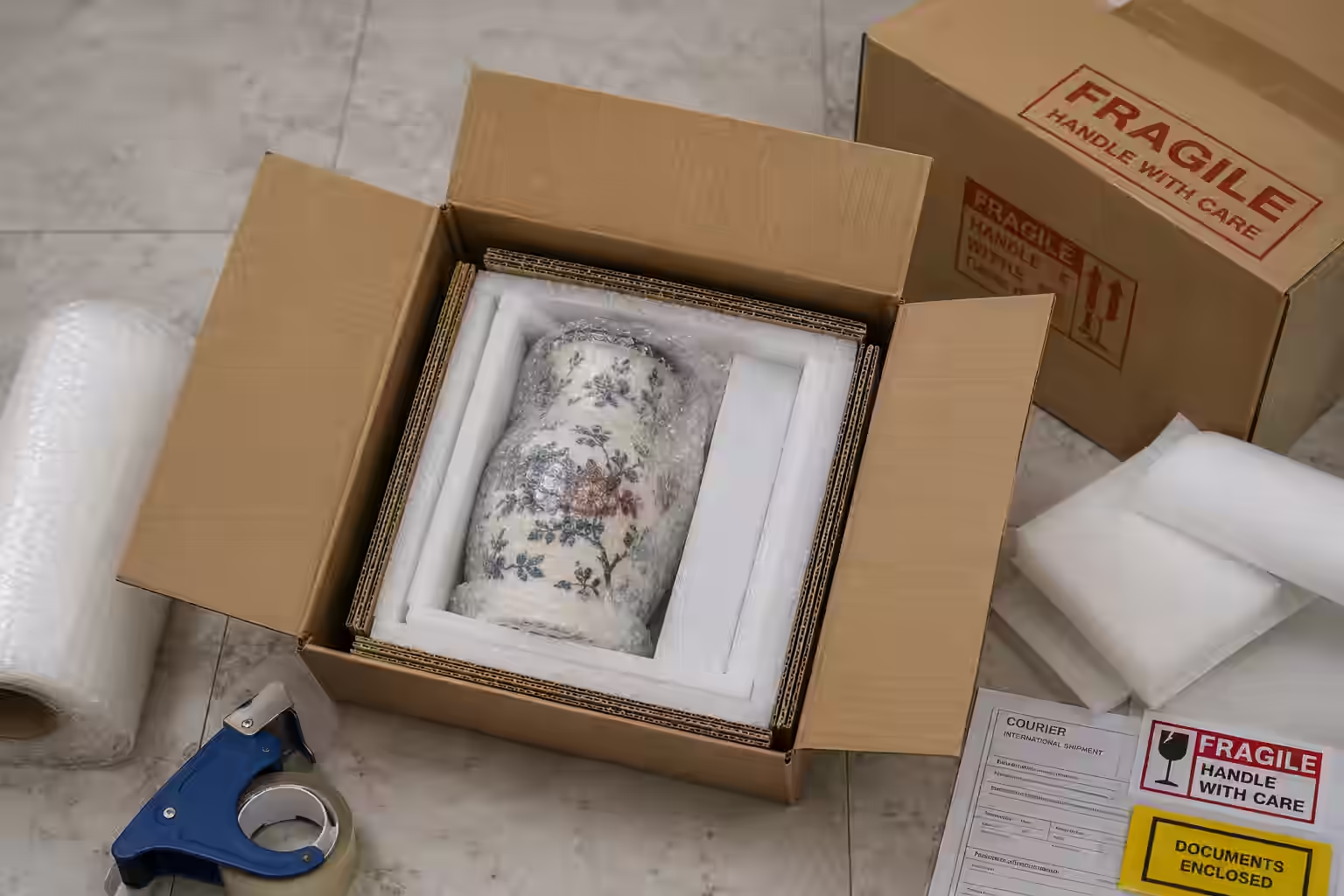
Crafts do not fail from being dropped nearly as often as they fail from being pressed, rubbed or vibrated for a week.
The common mistake is packing for a single dramatic impact when the real load is sustained. A carton stacked under others for eight hours does more damage than a fall, and continuous vibration is what loosens joints and abrades finishes.
Board grade matters more than people expect for dense craft pieces, and it is the commonest false economy in this category — our comparison of 10-ply vs 5-ply corrugated box guide explains why heavy crafts need the stronger grade.
- **Metal** — wrap to prevent surface contact, then cushion. Brass and copper scratch against each other and against carton board. Heavy pieces need the load spread rather than resting on one point.
- **Stone** — crate rather than carton anything substantial, and support protruding limbs and thin sections individually. Stone does not flex, so it transmits every shock straight to its weakest cross-section.
- **Wood** — cushion corners and carved detail, wrap breathably rather than sealing airtight so the piece is not trapped with its own moisture, and remember that any solid-wood crate needs an ISPM 15 heat-treatment mark.
- **Terracotta, ceramic and glass** — double-box with a cushioned gap between inner and outer, and never let two fragile pieces touch through their wrapping.
- **Mixed pieces** — dismantle where the design allows. A brass figure travels better off its marble base, with the two packed separately.
- Photograph every piece from all sides before packing. Those images are what an insurance claim is assessed against.
Step 05
Classification, duty and destination notes
Handicrafts are ordinary merchandise. What decides the paperwork is describing the material accurately rather than describing the occasion.
Classification follows the material: carved wooden articles and boxes fall under HS 4420, worked stone under 6802, and metal statuettes and ornaments under the relevant metal heading. An invoice reading "handicraft" or "gift item" cannot be classified and invites an inspection; "carved rosewood panel, 30cm" can.
- Describe the material and dimensions, not the purpose. "Decorative item" is not a classification.
- Declare an honest value. Under-declaring voids insurance on exactly the pieces most worth insuring.
- Name the artisan or workshop where you can — it supports both the value and the modernity of the piece.
- Keep quantities domestic unless you are shipping commercially and have said so.
| Destination | Position as of August 2026 |
|---|---|
| USA | De minimis was suspended for all countries on 29 August 2025, so every consignment is a formal entry regardless of value, with the reciprocal tariff on Indian goods cut from 50% to 18% on 2 February 2026. Wooden items also require a Lacey Act species declaration. |
| UK | Import VAT on the declared value and duty above £135. Genuine gifts between private individuals under £39 are free of both. |
| EU | Import VAT at the destination rate. From 1 July 2026 the EU removed its €150 duty exemption and applies a transitional flat duty of €3 per parcel. |
| Australia | The strictest inspection regime for anything wooden or organic. Timber items and any wood packaging must meet BICON conditions, with a packing declaration and likely inspection. |
| Canada, UAE, Singapore | Straightforward for crafts. Canada's courier de minimis from India is only CAD 20; the Gulf and Singapore apply VAT or GST above local thresholds. |
Verified 18 August 2026. ShipHit prepares the classification and confirms the position for your destination before dispatch.
Step 06
Guides for each craft
This page covers the rules every Indian craft export shares. These cover what changes by material and object.
Craft consignments often travel alongside other things from the same region, and the packing rules differ enough to be worth separating — if yours also carries textiles, see our guide to Saree & snack pickup guide for why fabric and hard crafts need separate inner packing.
Collection is from the workshop, gallery or home across Tamil Nadu, with most craft consignments routing through our Export handicrafts from Chennai and branches in Coimbatore, Tiruppur, Pondicherry and Mayiladuthurai.
Frequently Asked Questions
Can I send Indian handicrafts abroad by international courier?
Yes, and most crafts ship without difficulty. The two things that stop a consignment are the material and the age: certain protected materials cannot be exported at all, and anything over a hundred years old is an antiquity under Indian law. Everything else is a matter of describing the piece accurately and packing it for sustained pressure rather than a single impact.
Can I export sandalwood handicrafts from India?
Finished ones, yes. Sandalwood is prohibited for export in any form except fully finished handicrafts and machine-finished sandalwood products, so a completed carved figure, box or panel can be sent while raw sandalwood — blocks, chips, dust, offcuts and oil — cannot. If a piece is only part-finished, finish it before shipping.
Are peacock feather crafts allowed in international courier?
No. Export of peacock feathers is prohibited under India's EXIM policy, and the peacock is a Schedule I species under the Wildlife (Protection) Act, 1972. Trade in naturally shed feathers is not an offence domestically, which is why the crafts are sold openly in India, but that does not make them exportable. This catches out a large number of decorative and festival pieces.
What is an ASI non-antiquity certificate and do I need one?
It is a certificate issued by Expert Advisory Committees of the Archaeological Survey of India confirming that an object is not an antiquity, so it can be exported without argument. You need one whenever a modern piece could reasonably be mistaken for old — an antiqued finish, a temple-scale icon, or anything inherited. For an ordinary contemporary piece a dated maker's invoice with photographs is usually enough.
Can I export an antique statue or artifact from India?
No. Under the Antiquities and Art Treasures Act, 1972, an object more than a hundred years old is an antiquity, must be registered with the Archaeological Survey of India, and cannot be exported by a private seller. Age is assessed on the object itself, regardless of how or when you acquired it.
What is the HS code for Indian handicrafts?
It depends on the material rather than the craft. Carved wooden articles and boxes fall under HS 4420, worked monumental or building stone under 6802, and metal statuettes and ornaments under the heading for the relevant metal. ShipHit prepares the classification as part of the commercial invoice.
How should heavy stone or metal statues be packed?
Substantial stone pieces should be crated rather than boxed, with protruding limbs and thin sections supported individually, because stone does not flex and transmits shock straight to its weakest section. Metal pieces need wrapping to prevent surface contact before cushioning, and heavy items need their load spread rather than resting on a single point.
Does a wooden handicraft need anything extra?
Two things. If it travels in a solid wood crate, that crate must carry the ISPM 15 heat-treatment mark or it can be quarantined or destroyed on arrival. And for the USA, wooden items require a Lacey Act declaration naming the species and country of harvest — a vague description is a defective declaration rather than merely an unhelpful one.
Related shipping guides
More routes and guides not mentioned above.