
Home Product Courier · Courier Mode · Door Pickup · Customs Guidance
International Courier for Sending Kitchen Items and Home Products Abroad: What Ships, What Does Not, and What Customs Now Checks
Sending Indian kitchen items abroad used to be a question of packing: how to stop steel vessels denting each other and glass lids cracking under the weight. That part has not changed. The paperwork and the product rules have. Since August 2025 the FDA has warned specifically about Indian aluminium and brass cookware leaching lead, several US states have banned non-stick pans outright, and the USD 800 duty-free allowance most household parcels relied on no longer exists. This guide covers what still ships easily, what will now be stopped, why your mixer grinder will not run on American power, and what your declaration has to say.

Export & Logistics Specialist, ShipHit
Steel kitchenware
HS 7323
Brass and copper are 7418; aluminium is 7615.
US de minimis
Gone
Suspended for all countries on 29 August 2025.
UK gift relief
£39
Private individual to private individual only.
Indian mains
230V / 50Hz
The USA runs 120V / 60Hz. Converters do not fix motors.

Table of Contents
- What ships easily, and what does not
- The two US rules that now catch Indian cookware
- Electric appliances: the voltage problem nobody mentions
- Duty and import rules by destination
- Packing metal, glass and mixed household loads
- What you actually pay for
- Declaration wording that keeps a parcel moving
- Door pickup across Tamil Nadu
What ships easily, and what does not
Plain metal kitchenware is one of the most straightforward categories in international courier. The trouble starts with coatings, alloys, motors and pressure seals.
Steel vessels get heavy faster than almost anything else people send — a modest set of plates, tumblers and vessels reaches 5 to 7 kg without looking like much. ShipHit checks carton weight before packing and balances items across cartons, with each piece separated so nothing dents or rattles in transit.
- Ships easily: stainless steel plates, tumblers, lunch boxes, idli makers, dosa tawas and everyday steel cookware.
- Ships with care: pooja plates, brass and copper vessels, glass jars and ceramic serveware — all need separating from heavy metal.
- Ships only after a check: pressure cookers, non-stick pans, and anything with a motor or a battery.
- Does not ship: gas cartridges, lighters, aerosol sprays, loose lithium batteries, exposed blades, and any liquid or oil.
- Keep purchase bills for premium cookware — brand and value on the invoice speed up clearance and matter for insurance.
Pressure cookers are fine, sealed ones are not
A pressure cooker ships normally as steel or aluminium cookware provided it travels empty and unsealed, with the gasket and weight valve removed and packed separately. A sealed pressure vessel that cannot equalise is treated as a hazard in an aircraft hold and will be refused.
The two US rules that now catch Indian cookware
Both are recent, both are specific to the cookware Indian families send, and neither appears on most shipping advice.
For a US destination these matter more than anything about packing. They rarely stop a personal parcel at the border, but they decide whether the cookware is safe to use and, for a commercial shipment, whether it is admissible at all.
- The warning targets cooking surfaces. Decorative brass, pooja plates and serving items food is not cooked in are a different matter.
- Hindalium and Indalium are trade names for aluminium alloys common in inexpensive Indian cookware — check what your vessels actually are.
- Non-stick is banned outright in several states: Minnesota since January 2025, Colorado and Maine from January 2026, Connecticut and Vermont from 2028. California's proposed ban was vetoed in October 2025.
- Those PFAS laws restrict sale rather than personal possession, but they make non-stick a poor commercial shipment into those states.
- Stainless steel, cast iron and clay are unaffected by both rules and are the safest things to send.
FDA warning on Indian aluminium and brass cookware
In August 2025 the FDA issued safety communications about imported cookware made from aluminium, brass, and the alloys sold as Hindalium/Hindolium and Indalium/Indolium, which testing showed can leach lead into food during cooking. The FDA's position is that this cookware should not be distributed or sold in the US market, and it can place affected manufacturers under an Import Alert that detains future shipments automatically. Worth knowing before you pack Indian aluminium or brass cooking vessels for family in the USA.
Electric appliances: the voltage problem nobody mentions
A mixer grinder is the single most requested item in this category and the one most likely to be useless on arrival.
India runs on 230 volts at 50 hertz; the USA and Canada run on 120 volts at 60 hertz. An Indian mixer grinder plugged into American power through an adapter simply will not run, and a step-up converter is not a reliable fix for a motor: a 750W motor drawing around 3.3A at 230V needs roughly double that at 120V, and a grinder's startup surge can exceed what a domestic circuit and a consumer converter will tolerate. That is a fire risk, not an inconvenience.
- USA and Canada — 120V/60Hz. Indian 230V appliances will not work. Buy a 110V model; Preethi, Butterfly and others make them for this market.
- UK, UAE, Singapore, Australia and most of Europe — 220-240V. An Indian appliance works; you only need the right plug adapter.
- The 50Hz to 60Hz difference matters even at matched voltage — a 50Hz motor on 60Hz runs faster and hotter, shortening its life.
- Anything with a built-in rechargeable battery must be declared before booking. Lithium cells are restricted in air cargo and some are refused.
- Send the model number and a photo of the rating plate before booking — enough for ShipHit to confirm it can fly and will work on arrival.
The honest advice
For anywhere on 220-240V mains, shipping your Indian appliance makes sense. For the USA or Canada it usually does not — the freight on a heavy grinder often exceeds the price gap on a 110V model bought locally, which also carries a warranty that works where you live.
Duty and import rules by destination
Kitchenware is ordinary merchandise. Unlike artwork it carries no special exemption, so the destination's thresholds decide what your receiver pays.
Classification is straightforward: stainless steel kitchenware is HS heading 7323, brass and copper vessels 7418, aluminium articles 7615. The rates are low, but low is not zero, and the thresholds that used to absorb small parcels have been shrinking.
| Destination | Position as of August 2026 |
|---|---|
| USA | De minimis was suspended for all countries on 29 August 2025, so every consignment is a formal entry regardless of value. Expect the tariff rate for the heading plus the reciprocal tariff on Indian goods, cut from 50% to 18% on 2 February 2026. |
| UK | Genuine gifts between private individuals under £39 are free of VAT and duty. From £39 to £135, 20% VAT and no duty. Above £135, both apply. The gift relief survives the withdrawal of the commercial £135 duty relief. |
| EU and France | Import VAT applies from the first euro. From 1 July 2026 the EU removed its €150 duty exemption and applies a transitional flat duty of €3 per parcel. |
| Canada | De minimis for courier shipments from India is only CAD 20 — far below the CUSMA thresholds for US and Mexican goods. GST/HST applies above it. |
| Australia | GST applies above AUD 1,000. Wooden items and timber packing must meet biosecurity conditions on arrival. |
| UAE and Singapore | Low-value allowances apply, with VAT or GST above the local threshold. The simplest routes for household goods. |
Customs rules verified 17 August 2026. ShipHit confirms the current position for your destination before dispatch.
Packing metal, glass and mixed household loads
Metal kitchenware is durable in itself but hostile to everything packed beside it. Most damage in this category is caused by the contents, not the courier.
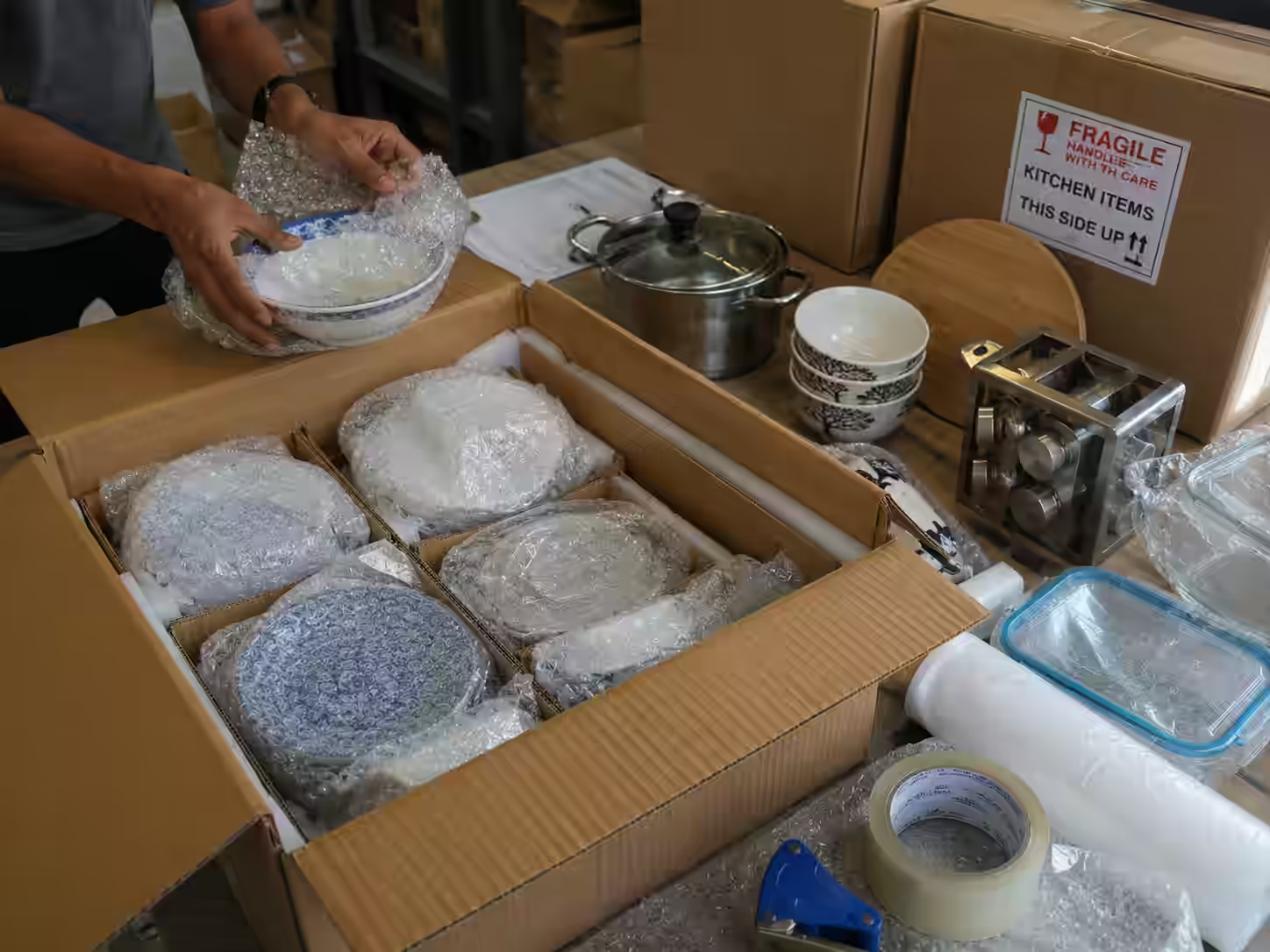
Strainer edges, cooker clips, ladle handles and tawa rims are sharp enough to pierce poly covers and ruin clothing in the same carton. Each piece is wrapped individually, stacked vessels get cardboard dividers, and glass and ceramic sit in their own inner layer, never under the weight of steel.
Carton strength genuinely matters with a load this dense, and it is the one thing people economise on that reliably costs them more — our comparison of 10-ply vs 5-ply corrugated box guide explains why a steel consignment needs the heavier grade.
- Nest vessels of similar shape with a divider between each — nesting saves volume, and volume is what you pay for.
- Wrap every handle, rim, clip and lid before it goes in the carton.
- Heavy cookware at the bottom, voids filled so nothing shifts.
- Use a double-wall outer carton. Steel concentrates its weight on the corners and a single-wall box will split.
- Write a separate packing list for each carton when the shipment runs to more than one box.
What you actually pay for
Kitchen items are unusual because they are often billed on real weight rather than box size — the opposite of most household parcels.
Courier charges follow whichever is higher, actual or volumetric weight. Most household categories are volumetric: light, bulky things priced on the space they occupy. Steel is the exception. Once actual weight overtakes volumetric, tighter packing stops saving money and splitting the load across cartons is what matters.
To work out the chargeable weight yourself before booking, the formula and worked examples are in our guide to Actual vs volumetric weight pricing guide which applies directly to a dense metal consignment.
Household shipments are rarely only kitchenware. If yours also carries festival items, see Pooja items & festival gifts guide before deciding how to split the cartons.
- Nest and stack to cut volume first, then check whether actual weight has overtaken it.
- Two moderate cartons handle and survive better than one overloaded box.
- Measure the box after cushioning is added, not before.
Declaration wording that keeps a parcel moving
Most household consignments that get held are held because the description was too vague to classify, not because anything in them was wrong.
Customs needs to know what each item is, what it is made of, how many there are and what it is worth. Words like parcel, gift and household item invite an inspection.
Some things people assume are ordinary household goods are restricted in air freight altogether — worth scanning our reference on Items not allowed in guide before you pack rather than after collection.
- Write item-wise values, not one combined figure for the whole box.
- Name the material every time — stainless steel, brass, copper, aluminium, glass, ceramic.
- State the purpose honestly: gift, personal use, sample or commercial order. A misdeclared gift is a common reason for a penalty.
- Keep sender KYC (PAN or Aadhaar) and the receiver's full address, postcode, phone and email ready before pickup.
Door pickup across Tamil Nadu
A carton of steel vessels is the last thing anyone should be carrying to a courier office, and the shipment most likely to need repacking before it flies.
The pickup team reviews the item list on site, flags anything restricted, suggests how to split the load, measures the cartons and collects the documents in one visit.
Most household consignments route through Chennai, where pickup, repacking and airport movement are coordinated in a single day — our Ship home products from Chennai handles the majority of NRI kitchen shipments.
Families in the western districts are served from Ship home products from Coimbatore with Tiruppur, Pondicherry and Mayiladuthurai covering the surrounding towns.
Frequently Asked Questions
Can steel utensils and cookware be sent abroad by courier?
Yes. Stainless steel plates, tumblers, vessels and cookware are among the most straightforward things to send by international courier. The constraint is weight rather than rules — a modest set reaches 5 to 7 kg quickly, so heavy loads are balanced across two cartons to stay within safe handling limits.
Can I ship an Indian mixer grinder to the USA?
You can ship it, but it will not work. India runs on 230V/50Hz and the USA on 120V/60Hz, so an Indian grinder will not run on American power, and a step-up converter is not a safe fix for a high-startup motor. Buy a 110V model made for the US market instead. For the UK, UAE, Singapore, Australia and most of Europe, all on 220-240V, an Indian appliance works with a plug adapter.
Is Indian aluminium or brass cookware allowed into the USA?
It is not banned from entry, but it is now flagged. In August 2025 the FDA warned that imported cookware made from aluminium, brass and the alloys sold as Hindalium/Hindolium and Indalium/Indolium can leach lead into food, and told retailers it should not be sold in the US market. For a personal parcel this is a safety question rather than a customs one; for a commercial shipment it can mean an Import Alert. Stainless steel, cast iron and clay are unaffected.
Can I send non-stick pans to the United States?
Not into every state. Minnesota banned the sale of cookware with intentionally added PFAS from January 2025, Colorado and Maine followed in January 2026, and Connecticut and Vermont take effect in 2028. California's proposed ban was vetoed in October 2025. The laws restrict sale and distribution rather than personal possession, but they make non-stick a poor choice for any commercial consignment.
Can a pressure cooker be sent by international courier?
Yes, provided it travels empty and unsealed. Remove the gasket and the weight valve and pack them separately, so the cooker is an ordinary metal vessel rather than a sealed pressure container. A sealed vessel that cannot equalise pressure is treated as a hazard in an aircraft hold and will be refused.
What is the HS code for steel kitchen items?
Stainless steel table and kitchen articles fall under HS heading 7323. Brass and copper vessels are classified under 7418 and aluminium articles under 7615. Getting the heading right on the commercial invoice is what stops a mixed household carton being held for classification.
Do I pay duty on kitchen items sent to the USA?
Almost certainly, now. The USD 800 de minimis allowance was suspended for all countries on 29 August 2025, so every consignment is a formal entry regardless of value. Kitchenware is ordinary merchandise with no special exemption — expect the tariff rate for the heading plus the reciprocal tariff on Indian-origin goods, reduced from 50% to 18% on 2 February 2026.
Can I send kitchen items to the UK as a gift without duty?
Yes, if the value is £39 or less and it is genuinely sent from one private individual to another. Between £39 and £135, 20% VAT applies with no customs duty. Above £135 both apply. A company sending to an individual does not qualify for the gift relief at any value.
Can pooja plates and brass vessels be sent abroad?
Yes. Pooja plates, small brass vessels and decorative home accessories ship normally when declared clearly by material and value. Because they are decorative rather than cooking surfaces, the FDA lead advisory does not apply to them. They do need cushioning away from heavy steel in the same carton.