
Art & Handicraft Courier · Courier Mode · Door Pickup · Customs Guidance
International Courier for Tanjore Paintings from India: HS Classification, Duty by Country and Export Documents
Most advice about shipping Tanjore paintings abroad still leads with the USD 800 de minimis rule. That rule no longer exists — the United States suspended duty-free de minimis for every country on 29 August 2025. There is a better answer underneath it, and it does not expire: a genuine hand-painted Tanjore artwork is a work of art, and works of art sit in a chapter of the tariff that carries no duty at all. This guide covers how that classification works, what disqualifies a painting from it, what you pay by destination, why an antique Tanjore painting can never legally leave India, and what your commercial invoice has to say.

Customs & Shipping Consultant, ShipHit
Classification
HS 9701
Paintings executed entirely by hand.
US Duty
Free
Chapter 97 works of art, with no value threshold.
UK Import VAT
5%
Reduced rate for art, against 20% standard. Duty is 0%.
Over 100 Years
Cannot Export
A protected antiquity under Indian law.
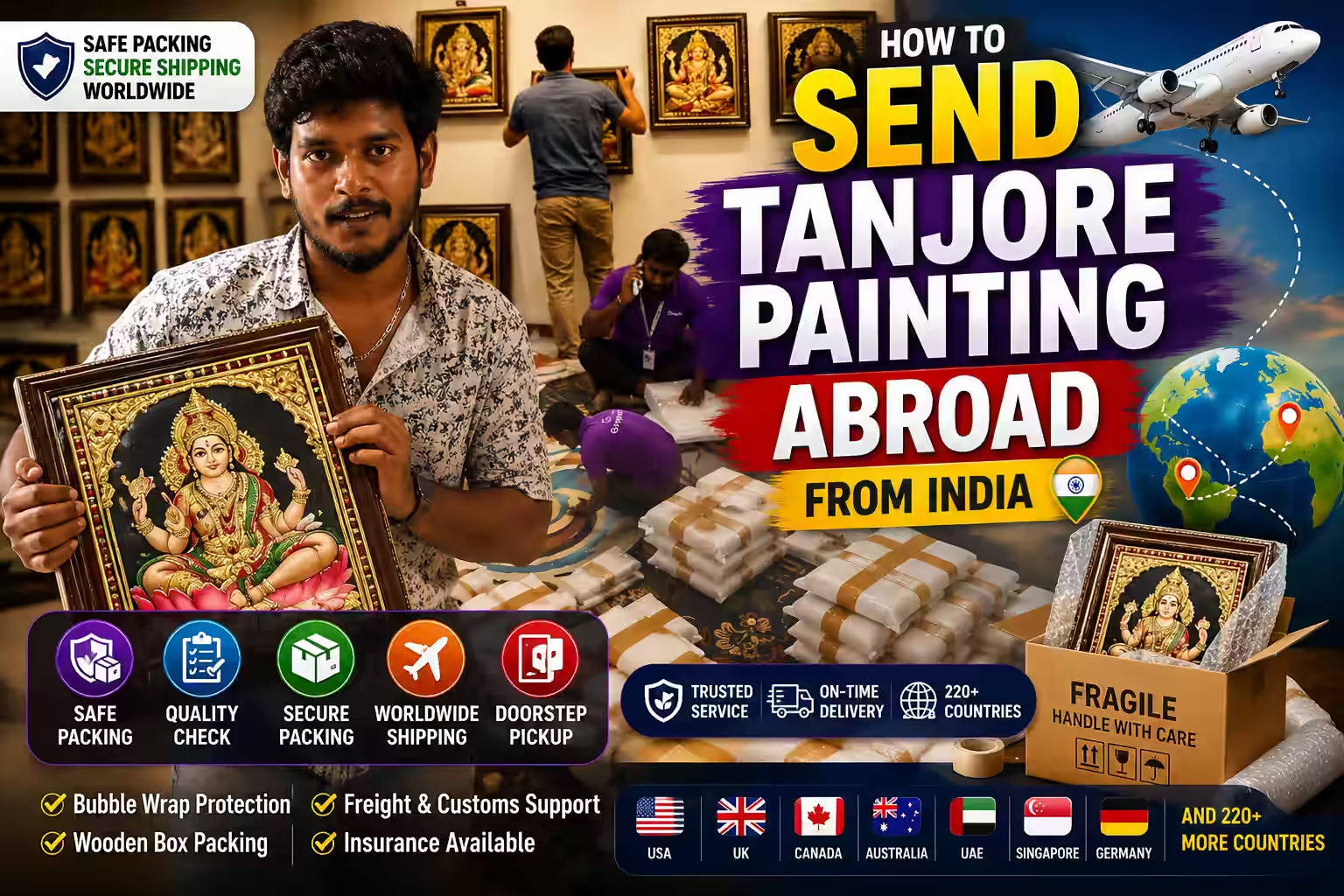

Table of Contents
Why Tanjore paintings are an unusual export
A Tanjore painting is three fragile things at once — a glass face, a gold leaf surface and an ornate wooden frame — and one of the few categories where customs classification can save you more money than anything else you do.
The physical risks are well understood: glass cracks under sustained pressure, the raised gesso and gold leaf surface is ruined by abrasion against the painted face, and ornate frame corners fail first on long-haul air routes. Those risks are solved by packing. What sellers consistently get wrong is the paperwork — specifically, how the artwork is described and classified at the border. Get that right and a painting worth USD 900 enters the United States with no duty at all. Get it wrong and the same painting is treated as a decorative manufactured article and taxed accordingly.
This page covers the customs and documentation side. For the six-layer packing method — the face-down-on-foam technique, corner protection and how to separate a bulk order so the bottom painting does not carry the weight of the stack — see our Ship tanjore painting packing guide guide which is written for exactly that job.
HS 9701: the classification that decides your duty
Heading 9701 covers paintings, drawings and pastels executed entirely by hand. Almost every country in the world admits them at zero customs duty — but the wording of that heading is doing a lot of work, and not every Tanjore painting qualifies.
Chapter 97 of the Harmonized System is reserved for works of art, collectors' pieces and antiques, and heading 9701 is the entry for original paintings. Goods classified there enter the United States free of duty, attract 0% customs duty in the United Kingdom, and are treated as art rather than merchandise across most of the EU. For a Tanjore artist or gallery, this is the difference between a routine delivery and an unexpected bill for your buyer.
- Describe the work honestly and specifically: the deity or subject, the dimensions, the board or canvas, the gesso relief, the 22k or imitation gold foil, and whether any stones are set.
- State that it is hand-painted and original, and name the artist where you can. Artist attribution is one of the clearest signals of an original work.
- Avoid the words handicraft, decorative panel or wall decor on the invoice for an original painting — each points a customs officer away from Chapter 97.
- Classify printed reproductions separately. Misdeclaring one to obtain zero duty puts the whole consignment at risk.
- Keep work-in-progress photographs where you have them — for a high-value piece, that is the simplest evidence it was executed by hand.
What qualifies, and what does not
Heading 9701 requires that the work be executed entirely by hand, and it explicitly excludes hand-painted or hand-decorated manufactured articles, mass-produced reproductions and works of conventional craftsmanship of a commercial character. A traditional Tanjore painting — hand-drawn on the board, hand-built gesso relief, gold foil laid by hand, hand-painted throughout — is an original painting. A printed Tanjore-style reproduction with foil and stones applied over the print is not, no matter how much handwork went into the finishing. If you sell both, they must be described and classified differently on the invoice.
Import duty and taxes by destination
Zero customs duty on a qualifying work of art does not mean zero tax. Duty and consumption tax are separate things, and it is usually the second one your buyer pays.
The table assumes an original hand-painted work correctly classified under HS 9701. A reproduction, or a work described on the invoice as a handicraft, is classified elsewhere and taxed at ordinary merchandise rates.
| Destination | Customs duty | Tax and notes |
|---|---|---|
| United States | Free | Chapter 97 works of art are duty-free with no value threshold, and original art is treated as exempt informational material under 50 U.S.C. 1702(b)(3), which shields artworks from tariffs imposed under emergency economic powers. The USD 800 de minimis allowance was suspended on 29 August 2025, so every consignment is now a formal entry — the Chapter 97 exemption is what protects you, not de minimis. |
| United Kingdom | 0% | Qualifying works of art attract a reduced import VAT rate of 5% instead of the 20% standard rate, charged on the CIF value. An open-edition print or poster does not qualify and is charged at 20%. |
| France and the EU | 0% | Reduced import VAT rates apply to works of art in most member states. Separately, from 1 July 2026 the EU removed its €150 customs duty exemption and applies a transitional flat duty of €3 per parcel to goods that are dutiable. |
| Canada | Free | Works of art enter duty-free, but GST/HST applies. Canada's de minimis for courier shipments from India is only CAD 20 — far lower than the CUSMA thresholds that apply to US and Mexican goods, and a common surprise for sellers. |
| Australia | Free | GST applies on consignments above AUD 1,000. Wooden frames and any timber packing must meet biosecurity conditions on arrival. |
| UAE and Singapore | Free or low | Works of art are lightly treated in both. VAT or GST applies above the local threshold. |
Customs rules verified 17 August 2026. ShipHit confirms the current position for your destination before dispatch.
Declare the real value
The declared value must be the genuine price the buyer paid. Under-declaring a USD 600 painting as USD 50 is customs fraud, it voids your insurance cover, and it risks seizure. Because a correctly classified original painting is duty-free into most markets anyway, there is rarely anything to gain from it.
Antique Tanjore paintings cannot leave India
This is the one rule with no workaround, and the one most often discovered too late.
Under India's Antiquities and Art Treasures Act, 1972, any artwork more than one hundred years old is an antiquity. Antiquities must be registered with the Archaeological Survey of India, and their export is prohibited — not restricted, not subject to a licence you can apply for as a private seller, but prohibited. A nineteenth-century Thanjavur painting inherited from family cannot legally be couriered to a buyer abroad, however genuine the sale.
The same hundred-year rule catches other Indian craft exports too, and the wider list of materials and categories that cannot cross a border is worth checking before you accept an order — we keep it in our reference on Items not allowed in guide alongside the restricted-materials rules.
- Anything over 100 years old is an antiquity and cannot be exported. Age is assessed on the work, not on when you acquired it.
- A painting in traditional style made recently is not an antiquity. Age is the only test that matters, not appearance.
- If the age is uncertain on an inherited piece, get it assessed before you list it for sale rather than after a buyer has paid.
- Buyers sometimes ask for an antique specifically. The honest answer is that a genuine one cannot be shipped, and a contemporary piece by a named Thanjavur artist can.
Documents required for Tanjore painting export
Short list. The commercial invoice does almost all the work, and the description field on it is the single most valuable thing you will write.
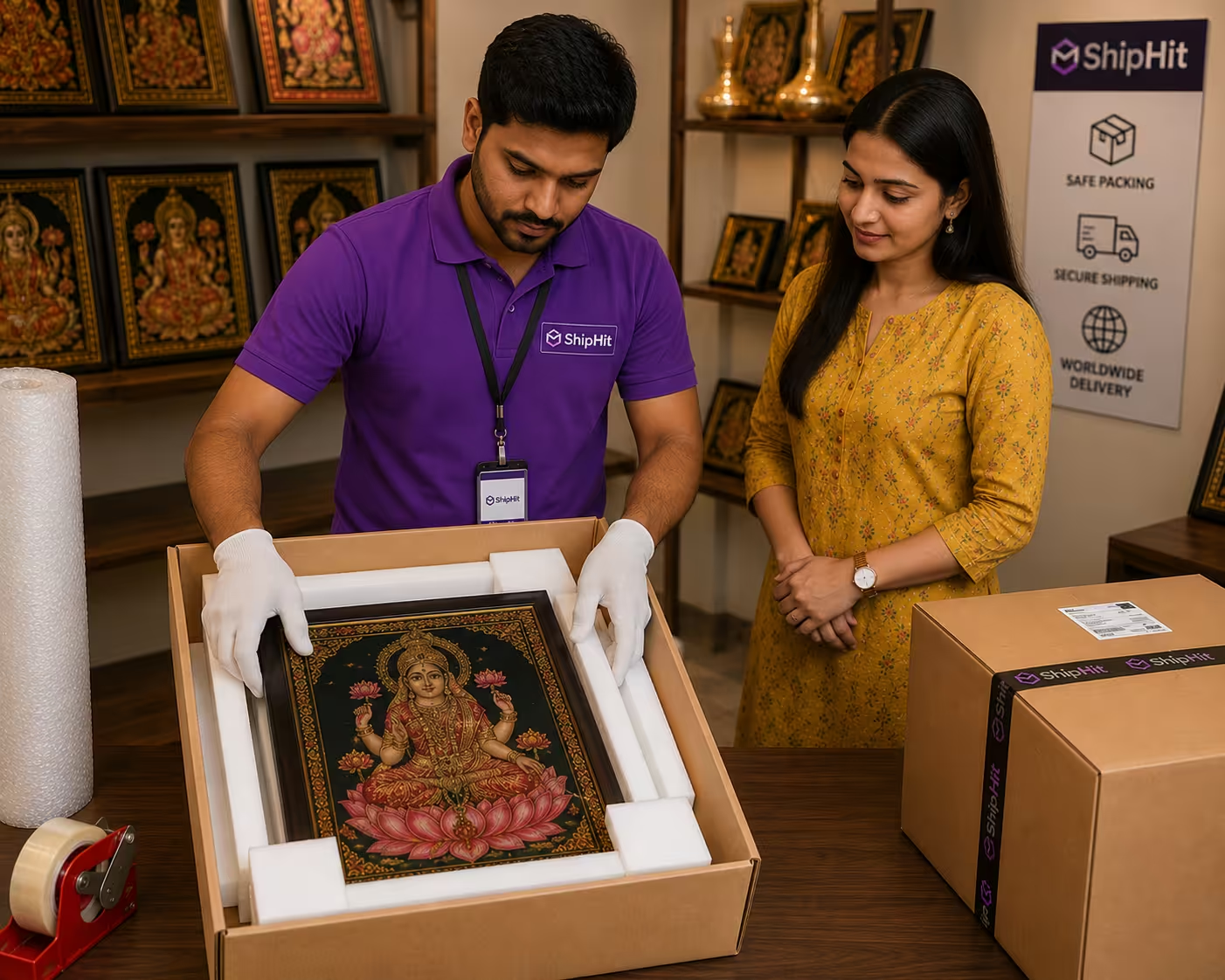
ShipHit prepares the commercial invoice and HS classification, and raises a grouped invoice for bulk orders so a fifty-painting shipment clears as one entry rather than fifty.
- Commercial invoice with a specific description — subject or deity, dimensions, materials, gold foil type, and the words hand-painted original where accurate.
- HS classification — 9701 for an original hand-executed painting; a different heading for printed reproductions.
- Declared value in USD at genuine fair market value, with the artist's name where available.
- Sender KYC — PAN or Aadhaar, plus an IEC code for regular commercial exporters.
- Buyer's full name, delivery address and a contact number that works in the destination country.
- Condition photographs taken before packing — front, back and all four corners. These are what an insurance claim is settled against.
Selling on Etsy, Instagram or in bulk
Most Tanjore paintings leaving India now go to a buyer who found the artist online, and the export mechanics are slightly different from a one-off family gift.
For individual online orders the pattern is simple: book a pickup per order, ShipHit packs and documents it, and the buyer receives it at their door. Because a correctly classified original painting is duty-free into most markets, the buyer's landed cost is usually just the item and the shipping — worth stating plainly on your listing, since many overseas buyers assume Indian art attracts heavy duty and hesitate for that reason alone.
Sellers pricing an order for the first time usually want to understand why a large flat parcel costs what it does, since a framed painting is billed on the space it occupies rather than its weight — we set out the formula and worked examples in our guide to Actual vs volumetric weight pricing guide which applies directly to framed art.
- For bulk orders, ShipHit packers work on site at your home, studio or gallery, so nothing has to be transported uncrated.
- Each painting is photographed and packed individually with foam separation before going into outer cartons — paintings are never stacked face to face.
- One grouped commercial invoice covers the consignment, with each work described and valued separately on it.
- Transit is 5–8 working days to the USA and 4–7 to the UK and Europe, door to door, excluding any customs examination.
- Insure at the honest declared value. For a gallery consignment this is not optional — glass and gold leaf are the two least forgiving materials in air freight.
Door pickup from the Thanjavur art belt
ShipHit collects from the artist's studio, your home or your gallery across Tamil Nadu — nothing framed and glazed should be travelling to a depot in the back of a car.
Thanjavur and the surrounding towns remain the centre of the craft, which carries a Geographical Indication tag tying it to the region. Most consignments originate within that belt or route through Chennai for export packing.
Chennai is the main export gateway for South Indian art and the point most consignments clear through, handled by our Export paintings from Chennai with on-site packing available for gallery-sized orders.
Artists working in and around the Cauvery delta are served from our branch at Export paintings from Mayiladuthurai which sits closest to the traditional Thanjavur workshops and collects the same week a commission is finished.
There is a steady flow of framed art and gifting orders from the western districts too, collected through our Export paintings from Coimbatore and neighbouring Tiruppur.
Pondicherry's galleries ship regularly to French and wider European buyers, served by our Export paintings from Pondicherry with the same specialist art packing on every consignment.
Frequently Asked Questions
Are Tanjore paintings duty-free in the USA?
Yes, but not for the reason most guides give. The USD 800 de minimis allowance was suspended for all countries on 29 August 2025. What protects a Tanjore painting is its classification: an original work executed entirely by hand falls under HS heading 9701 in Chapter 97, which enters the United States free of duty with no value threshold. A printed reproduction does not qualify.
What is the HS code for a Tanjore painting?
An original Tanjore painting executed entirely by hand is classified under HS heading 9701, which covers paintings, drawings and pastels executed by hand. Printed or machine-produced Tanjore-style reproductions with applied foil are not covered by 9701 and must be classified separately. Getting this right on the commercial invoice is the single most valuable thing on your paperwork.
How much import VAT will my UK buyer pay?
Qualifying works of art attract a reduced UK import VAT rate of 5% rather than the 20% standard rate, and 0% customs duty, charged on the CIF value. The reduced rate depends on the work qualifying as an original painting under Chapter 97 — an open-edition print or poster is treated as ordinary merchandise and charged at 20%.
Can I export an antique Tanjore painting over 100 years old?
No. Under India's Antiquities and Art Treasures Act, 1972, any artwork more than one hundred years old is an antiquity, must be registered with the Archaeological Survey of India, and cannot be exported. This applies regardless of how the piece was acquired or how genuine the sale is. A contemporary painting in traditional style is not an antiquity and ships normally.
Can I ship 100 Tanjore paintings to the USA at once?
Yes. ShipHit handles bulk art export orders, with packers working on site at your home, studio or gallery. Each painting is photographed and packed individually with foam separation, never stacked face to face, and the consignment travels under one grouped invoice with each work valued separately.
Does the gold leaf get damaged in shipping?
Gold leaf and raised gesso relief are ruined by abrasion if the painted face contacts any packaging material. The protection is the packing method rather than the courier: the painting travels face-down against a thick foam pad, so if the glass does crack, the breakage falls away from the painted surface instead of onto it.
Should I insure a Tanjore painting shipment?
Yes for anything of real value, and always for a gallery consignment — glass and gold leaf are the two least forgiving materials in air freight. Insure at the honest declared value and rely on the condition photographs taken before packing, which are what a claim is assessed against.
How long does it take to courier a Tanjore painting to the USA or UK?
Around 5–8 working days to the USA and 4–7 days to the UK and Europe by tracked air freight, door to door, excluding any customs examination. Specialist packing adds a short preparation window before dispatch, and longer for a bulk order packed on site.