
International Courier for Veena from India: Packing, Volumetric Cost, Customs and Delivery to the USA, UK, France and Dubai
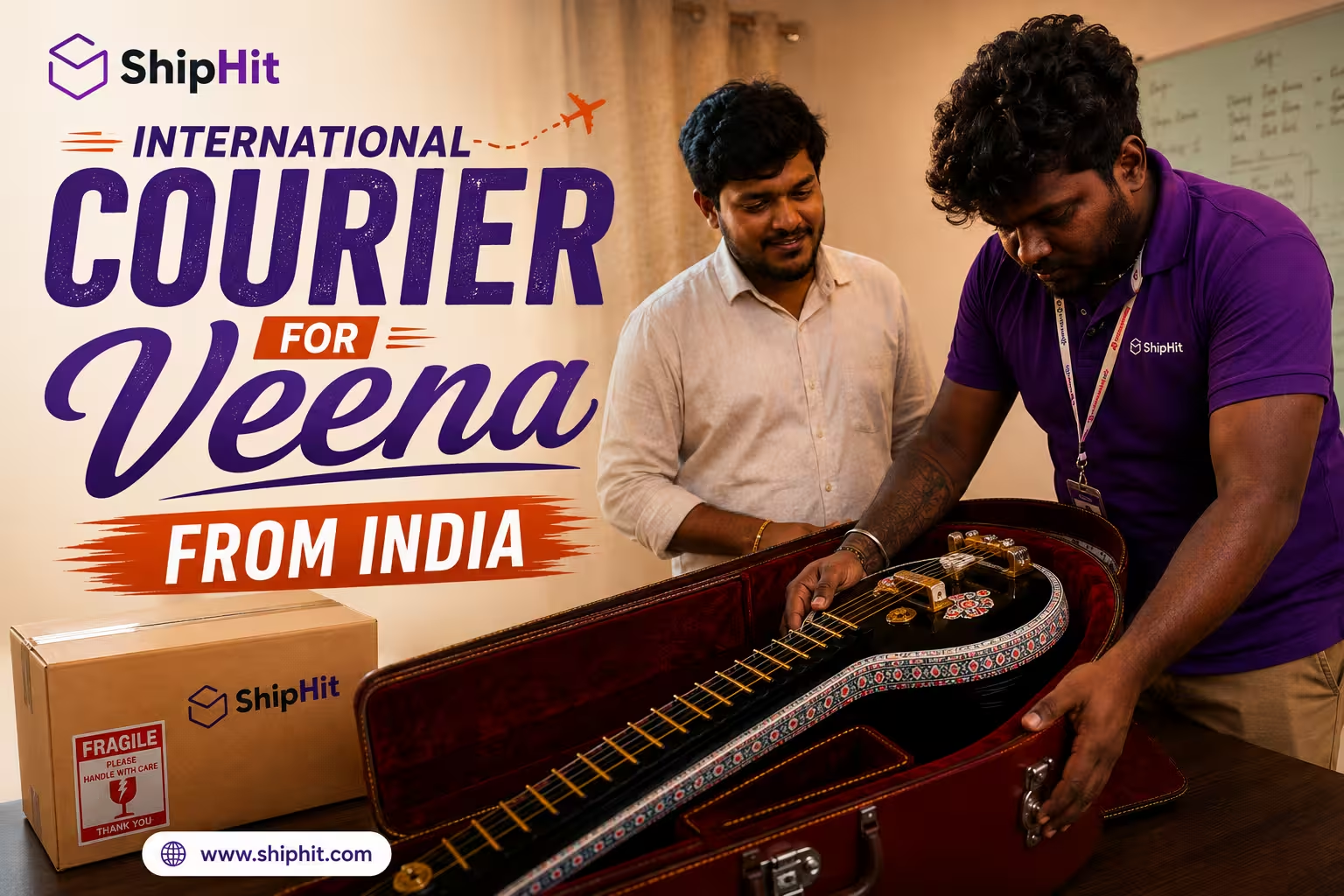
A full Saraswati Veena is close to four and a half feet long and hollowed from a single block of jackwood. It carries 24 brass frets set in soft wax, a carved yali head, and strings sitting under tension. None of that survives being treated like an ordinary parcel. Pack it in bubble wrap and a long tube, and the resonator arrives cracked or the frets work loose and rattle around inside the box.
In short: international courier for a Veena from India means a chargeable volumetric weight of roughly 65-70 kg, a 141 x 44 x 40 cm fiber case mounted on an ISPM 15 heat-treated pallet, and HS code 9202.90 on the invoice. No CITES permit is needed unless the instrument carries ivory inlay. Transit is 5-8 working days to the USA and 4-7 to the UK and Europe.
This guide covers the build choice that decides your freight bill, how the instrument is crated step by step, what the cost is actually based on, and the customs position on each major route — including the two rules that changed in 2025 and 2026, and the rosewood permit that was scrapped back in 2019.
Chargeable weight
65-70 kg
Case size
141 x 44 x 40 cm
HS code
9202.90
USA transit
5-8 days

Export & Logistics Specialist, ShipHit
The challenge
Why a Veena Cannot Travel Like a Normal Parcel
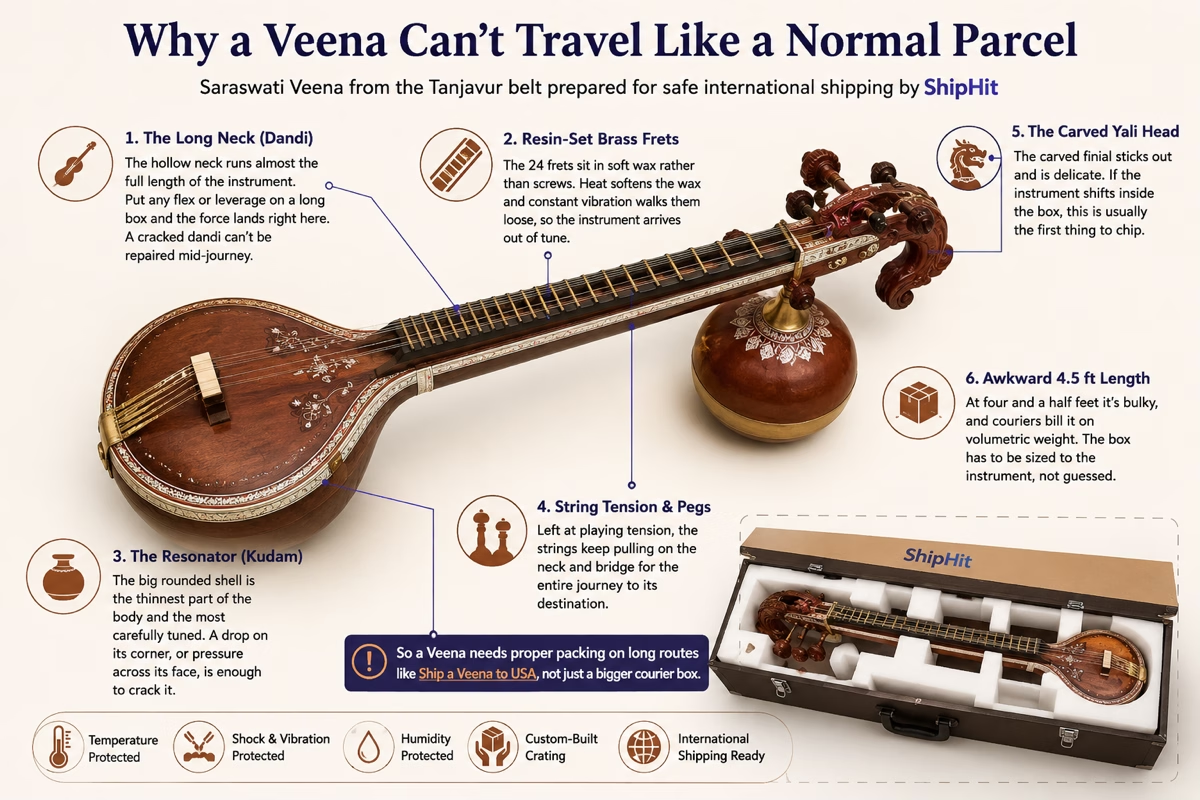
Almost every part of a Veena is a potential weak point, and they fail in different ways for different reasons.
The dandi cracks
The long hollow neck takes a permanent bow or splits outright if the outer box flexes under a stacked load. It is the failure that cannot be repaired invisibly.
The frets work loose
All 24 brass frets sit in a bed of soft wax. Heat softens the wax, vibration walks the frets out of position, and the instrument arrives unplayable even though nothing looks broken.
The kudam shells
The resonator is thin-walled and cracks under point pressure. A single carton stacked on the wrong part of the curve for eight hours is enough.
The yali head chips
The carved head is the most exposed part of the instrument and the first thing to catch the casing whenever the Veena shifts inside it.
String tension never lets up
Left at pitch, the strings keep pulling on the neck and bridge for the entire journey — days of sustained load on the joint you least want to move.
The length sets the price
At 4.5 feet it is bulky enough to be billed on volumetric weight rather than actual weight, which is why a Veena costs what it does to send.
A Veena is not a difficult thing to ship. It is a specific thing to ship.
Before you book
Ekanda or Jointed? The Choice That Decides Your Freight Bill
Veenas come in two builds, and the difference matters more to your shipping cost than any packing decision made afterwards.
An ekanda Veena is carved from a single block of jackwood — resonator, neck and head in one continuous piece. It is the prized build, the one serious performers want, and it cannot be taken apart. It ships at its full 4.5-foot length, and nothing about the packing can change that.
A jointed Veena, sometimes called a thattu Veena, has a detachable resonator. It separates into two shorter pieces that nest into a much smaller case, which means a materially lower volumetric weight and a materially lower freight cost. It reassembles in minutes and, for a student instrument, the tonal difference rarely justifies the extra shipping.
| Ekanda (single block) | Jointed / thattu | |
|---|---|---|
| Construction | One piece of jackwood throughout | Detachable resonator |
| Ships as | Full 4.5 ft length | Two shorter sections |
| Typical case | 141 x 44 x 40 cm | Noticeably shorter case |
| Volumetric weight | ~65-70 kg | Materially lower |
| Reassembly | None needed | A few minutes on arrival |
| Best for | Concert instruments where tone is the priority | Students, gifts and anyone shipping on a budget |
Ask before it is carved
If you are ordering a Veena to be shipped abroad, raise the jointed option with the maker at the point of order. This is the only reliable way to reduce the freight cost, and it has to be settled before the instrument is made — no amount of clever packing shrinks an ekanda Veena.
The method
How ShipHit Crates a Veena, Step by Step
Take the strain off the instrument first, then let the packing absorb any knocks instead of the wood.
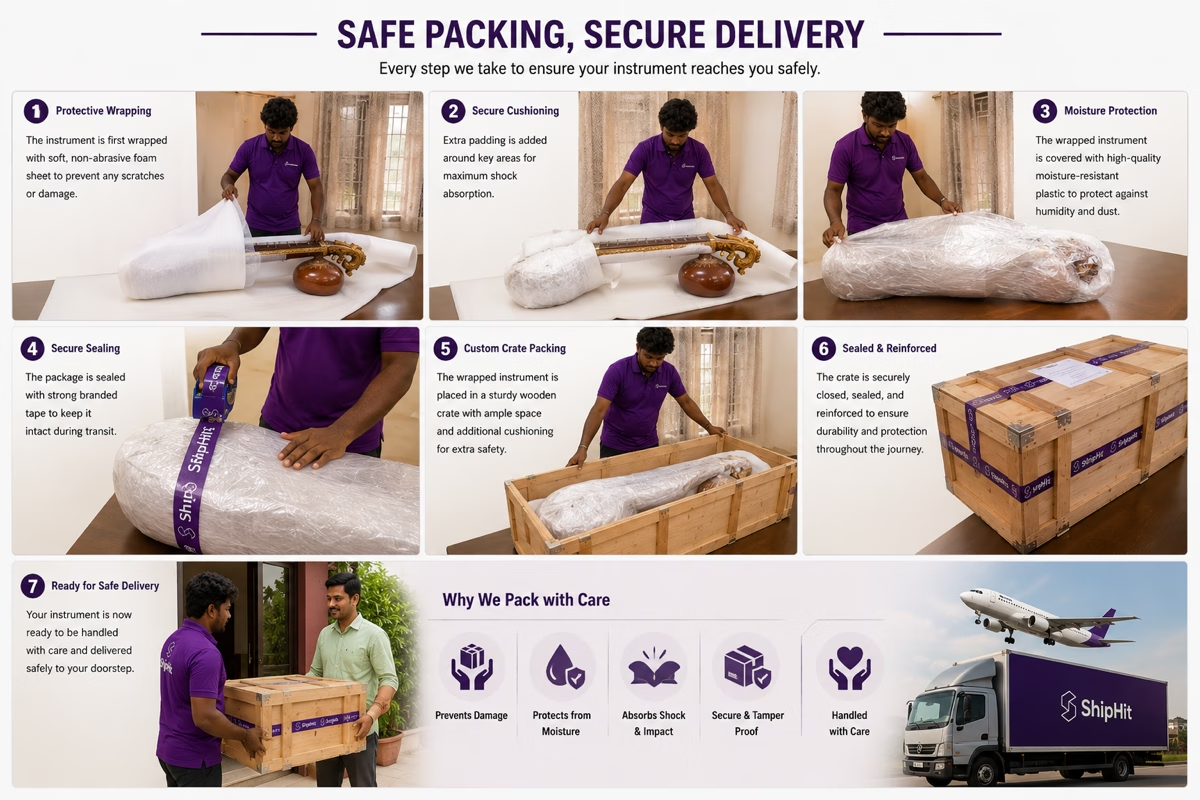
- 1
Step 1
Condition audit
Before anything is wrapped, the Veena is photographed from every side — resonator, neck, fret bed and yali head — so its exact condition is on record. These images are what an insurance claim would be settled against.
- 2
Step 2
De-tension and lock the frets
The strings are loosened to take the load off the neck and bridge. The fretboard is then wrapped so the wax-set frets cannot move laterally, and the pegs are taped down.
- 3
Step 3
Cradle the body
The neck is supported so it cannot flex independently of the body, the instrument is wrapped, and thermocol is packed around the resonator so nothing presses on a single point of the thin shell.
- 4
Step 4
Fiber casing box
The cradled instrument goes into a rigid fiber casing cut to its size — snug enough that it cannot slide around inside, because movement inside the case is what chips the yali head.
- 5
Step 5
Mount on a heat-treated pallet
The casing is fixed onto an ISPM 15 stamped wooden pallet so the whole assembly moves as one unit and a forklift never touches the casing itself.
- 6
Step 6
Label, mark fragile and dispatch
Sealed, marked fragile, and labelled with the destination and customs details, ready for tracked door-to-door air freight.
The casing itself matters as much as what goes inside it. If you are curious why an export-grade rigid case behaves so differently from a standard carton under stacking load, it is worth reading how box ply rating affects fragile shipments before you pack anything valuable yourself.
Why the pallet carries an ISPM 15 stamp
Solid wood packaging entering the USA, the EU, the UK or Australia has to be heat-treated and marked under ISPM 15, the international phytosanitary standard for wood packaging material. The mark is the IPPC wheat symbol carrying a country code, a producer code and the treatment code HT.
Without it the pallet can be quarantined, treated at your cost, re-exported or destroyed on arrival — with your Veena still bolted to it. This is the most common way an otherwise well-packed instrument gets held at the border, and it has nothing to do with the instrument itself.
Australia is the strictest destination
A wooden instrument on a wooden pallet is close to a worst case for Australian biosecurity. Alongside ISPM 15 marking, the shipment needs a packing declaration and may be inspected on arrival under the Department of Agriculture's BICON import conditions. If a risk is identified, goods can be treated, re-exported or destroyed at the importer's expense.
None of this makes Australia difficult — it makes it a destination where the paperwork has to be right before the box leaves India. ShipHit files the packing declaration as part of the export documentation on every Veena consignment to Australia so the shipment clears without a hold.
The cost
Volumetric Weight and What a Veena Costs to Ship
A Veena weighs a few kilos. That is not what you pay on, and understanding why is the difference between an expected invoice and a shock.
Air freight is billed on whichever is higher: the actual weight, or the volumetric (dimensional) weight worked out from the size of the box. With a case this large it is almost always the volumetric figure that sets the price. For a standard full-size ekanda Veena that usually lands around 65-70 kg.
It is not a fixed rate. The exact figure depends on your instrument's dimensions and the courier's volumetric divisor, so treat it as a guide rather than a quote. It is also why a snug casing matters commercially and not just structurally — an oversized box inflates the volumetric weight and the cost along with it.
- Chargeable weight — The volumetric weight of the finished case — around 65-70 kg for a full ekanda Veena, materially less for a jointed build.
- Destination zone — The USA and Canada price differently from the UK, the EU, the Gulf and Australia. Distance is not the only variable; route capacity matters too.
- Crating — The fiber case, the ISPM 15 pallet and the labour are a one-time cost on top of freight, not part of the per-kg rate. A Veena needs real crating, so this is never zero.
- Duty and taxes at the far end — Payable by the receiver in most countries — and, since the US ended de minimis in 2025, no longer avoidable on any American shipment at any value.
Because chargeable weight varies with the instrument's own dimensions, ShipHit measures the finished case and confirms the exact landed cost in writing before anything is collected. If you would rather work through the arithmetic yourself first, we have set out how volumetric weight is calculated against actual weight with the formula and worked examples.
A fair number of people ask whether it is cheaper to simply carry the instrument onto the plane. It sometimes is, but a Veena exceeds standard baggage dimensions on most carriers, travels without crating and without meaningful insurance, and depends on check-in staff accepting it on the day. We have compared the two approaches in our guide to excess baggage versus international courier if you are weighing it up.
Should you insure it?
For a concert-grade instrument, yes. Insure at the honest declared value, keep the maker's receipt, and rely on the condition-audit photographs taken before packing — those images are what a claim is assessed against. For a student Veena the crating usually does the work on its own, but the cover is inexpensive relative to the instrument.
Customs
Customs, Duty and Import Rules by Country
Musical instruments are not restricted goods, so a Veena leaves India and clears import normally. Two things decide how smoothly: the value you declare, and what the instrument is made of.
The rules on this route have moved twice in the last eighteen months, and a lot of advice still circulating online is out of date. Here is the position as it actually stands.
| Destination | Import position as of August 2026 |
|---|---|
| USA | The USD 800 de minimis allowance was suspended for all countries on 29 August 2025 under Executive Order 14324, and made indefinite for all non-postal modes in June 2026. Every Veena entering by courier or air freight is a formal customs entry regardless of value. Duty is the rate for HS 9202.90 plus the reciprocal tariff on Indian-origin goods, reduced from 50% to 18% under the US-India trade agreement of 2 February 2026. |
| UK | Import VAT applies on the declared value, and most full Veenas sit above the £135 threshold. The customs duty relief on consignments under £135 is being withdrawn in October 2028. |
| France / EU | From 1 July 2026 the EU removed the €150 customs duty exemption and applies a transitional flat customs duty of €3 per parcel, alongside import VAT at the destination rate. Full abolition follows with the EU Customs Data Hub in January 2028. |
| Dubai / UAE | Customs duty and VAT apply on the CIF value above the personal allowance. Rates are low relative to the other routes here. |
Declare the real value
Declare the genuine value the buyer paid. Under-declaring a Veena to reduce duty is customs fraud and risks seizure of the instrument. ShipHit prepares commercial invoices with honest values only.
The US change catches sellers out most often, because the USD 800 figure was true for years and is still repeated widely. It is worth reading the Federal Register notice implementing the suspension if you want the primary source rather than a summary.
For the European position, the European Commission announcement on removing the €150 threshold sets out the transitional arrangement in full.
The rule most senders get wrong
Rosewood, Ivory and the CITES Rules That Actually Apply
Most people worry about the wrong material here, so it is worth being precise about which rule bites and which one was scrapped years ago.
What genuinely blocks a Veena shipment
- Ivory inlay. Some older Veenas carry ivory inlay on the yali head or along the fretboard edge. Ivory is CITES Appendix I, banned from domestic trade in India under the Wildlife Protection Act 1972, and prohibited on import into the USA, UK, EU and Australia. An ivory-inlaid Veena cannot be exported — the maker must replace the inlay with bone or synthetic material and document the replacement first.
- An untreated wooden pallet or crate. Wood packaging without the IPPC heat-treatment mark is refused, treated at your cost or destroyed at the border, regardless of how well the instrument inside it is packed.
- An under-declared invoice value. It is customs fraud, it voids your insurance cover, and it risks seizure of an instrument worth far more than the duty avoided.
Veenas over 100 years old
An instrument more than a century old counts as an antiquity under India's Antiquities and Art Treasures Act, 1972, and needs registration and age clearance before it can leave the country. A modern jackwood Veena from a working maker needs none of this.
Rudra, Vichitra and Chitravina
The same crating approach covers the Rudra Veena, the Vichitra Veena and the Chitravina (Gottuvadhyam), along with Tanjore and Mysore-style instruments. The fragility points differ slightly — a Rudra Veena's two gourds each need individual cradling — but the method is the same.
Shipping more than one instrument
The 2019 CITES exemption applies right across the instrument category, and the packing principles carry over to fretted instruments too. See the guitar courier guide
Materials that stop a consignment
Ivory is not the only restricted material worth checking before you pack an instrument or its accessories. What cannot be sent by courier
Rosewood needs no permit
In 2017 the entire Dalbergia genus — rosewood — went under CITES Appendix II, and for two years instruments genuinely did need permits to cross borders. That is where the advice you have probably read comes from.
At CITES CoP18 in August 2019 the Conference of the Parties adopted Annotation #15, exempting finished musical instruments, finished parts and finished accessories made from rosewood from the permit requirement. The official notification took effect on 26 November 2019. A Veena is a finished musical instrument, so rosewood in the neck, pegs or trim needs no CITES permit to be couriered from India.
The one exception is Dalbergia nigra, Brazilian rosewood, on Appendix I since 1992 and not covered by the exemption. It is not used in Veena making, so in practice no Veena is caught by it.
Tell ShipHit the materials and the rough age at the quoting stage, and the team raises only the paperwork your specific instrument actually needs — which, for the great majority of Veenas, is none of the above.
Paperwork
Documents Required for Veena Export
Short list, and most of it is information you already have. The classification is the part worth getting right.
ShipHit prepares the commercial invoice and the HS classification, and raises an antiquity clearance only where the specific instrument requires one. No CITES paperwork is needed for rosewood on a finished instrument.
What ShipHit needs from you
- Instrument description — Saraswati Veena, ekanda or jointed, dimensions, wood, and any rosewood or inlay materials
- HS classification — 9202.90, filed as HSN 92029000 on Indian export documentation
- Declared value — honest fair market value in USD
- Sender KYC — PAN or Aadhaar
- Buyer's full name, delivery address and a working contact number
- Antiquity age clearance — only for Veenas over 100 years old
Destinations
Where ShipHit Sends Veenas
Door to door to Carnatic music students, teachers and performers worldwide, with the same crating standard on every route.
| Destination | Typical transit | Notes |
|---|---|---|
| USA | 5-8 working days | Formal customs entry on every consignment since de minimis ended |
| UK and Europe | 4-7 working days | Import VAT on arrival; EU parcels carry the flat €3 duty |
| France | 4-7 working days | Strong buyer base through European Carnatic circles |
| Dubai / UAE | 3-5 working days | Fastest of the major routes |
| Canada | 6-9 working days | Door delivery with full customs handling |
| Australia | 7-10 working days | Packing declaration and possible biosecurity inspection |
| Singapore and Malaysia | 4-6 working days | Established route for teaching institutions |
| Germany and New Zealand | 5-9 working days | Same crating standard, EU and NZ import rules respectively |
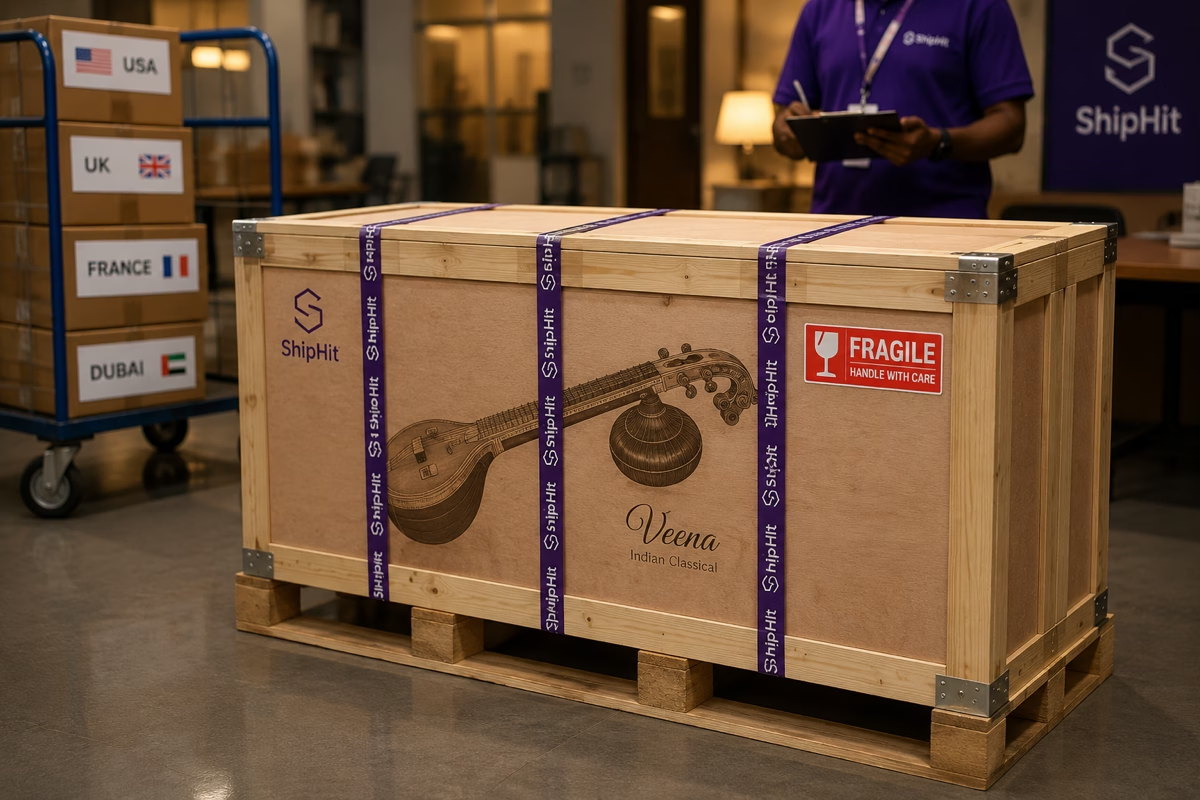
The USA is by far the busiest route, largely because of the Carnatic teaching community across New Jersey, Houston, Dallas and the Bay Area, and it is where most first-time senders start. Our international courier service to the USA page sets out transit, tracking and customs handling in detail.
For students and performers in Britain, the courier route to the UK runs on the same crating standard with a slightly shorter transit window.
European buyers are most often served through France, and the Gulf through Dubai — both run on the same door-to-door basis as our courier service to France with customs handled at both ends.
Pickup network
Door Pickup from the Thanjavur Veena Belt
ShipHit collects from the maker's workshop, your home or your music school — nobody should be moving a 4.5-foot instrument to a depot.
The Thanjavur-Mayiladuthurai-Kumbakonam corridor is the heartland of Veena making, and has been for generations. The Thanjavur Veena carries a Geographical Indication tag, and the single-block ekanda instruments that come out of this belt are what most overseas buyers are actually looking for. Nearly every Veena ShipHit exports originates within a short radius of it.
Mayiladuthurai sits at the centre of the craft cluster, close enough to the workshops that an instrument can be collected the same week it is finished, which is why our international courier service in Mayiladuthurai handles more instrument consignments than any other branch.
Chennai is the Carnatic music hub and the main NRI export point for South Indian instruments, so most consignments route through our international courier service in Chennai for export packing and documentation.
There is a strong music-school and NRI community around Coimbatore sending instruments abroad, served by our courier service in Coimbatore with the same doorstep collection.
Pondicherry's cultural community has long-standing connections with European buyers, and we collect there through our Pondicherry international courier branch for France and the wider EU.
Tiruppur is an NRI gifting hub with frequent instrument orders for students overseas, and our courier service in Tiruppur covers the surrounding belt.
The same region exports far more than instruments, and the crating principles carry across — if you are sending other work from the Thanjavur belt, our guide to shipping Tanjore paintings abroad covers the packing and customs side for that craft.
What to avoid
Mistakes That Ruin a Veena in Transit
Almost every damaged Veena we have seen failed for one of these reasons, and all of them are avoidable before the box is sealed.
- 1Shipping at full string tension. The single most common error. Days of sustained pull on the neck and bridge, plus vibration, is how a dandi arrives bowed.
- 2Removing the strings completely. The opposite mistake. Loosen them — do not strip them. Some residual tension keeps the assembly stable.
- 3Using an oversized box. It inflates the volumetric weight you are billed on and lets the instrument move inside the case. More cost, worse protection.
- 4Leaving the frets unwrapped. Wax-set frets walk out of position with heat and vibration. The instrument arrives intact but unplayable, and re-setting 24 frets is a specialist job.
- 5A soft case or a long tube. Neither offers structural resistance to stacking. A Veena needs a rigid case on a pallet, not padding in a cardboard cylinder.
- 6Not photographing before packing. Without a documented pre-shipment condition, an insurance claim becomes your word against the carrier's.
If you would rather not take any of this on yourself, our team crates instruments to export standard every week — send photographs and we will advise, or schedule a doorstep pickup for your Veena and we will handle the casing, pallet and documentation end to end.
After delivery
When Your Veena Arrives
The instrument will not be playable the moment you open the box, and it is not supposed to be.
A Veena that has crossed a climate boundary needs to settle before it is touched. Leave the sealed case in the room it will live in for at least a day so the wood equilibrates gradually — opening a cold case into a warm humid room, or a humid case into dry central heating, is how a resonator cracks after a journey it otherwise survived perfectly.
- Acclimatise before opening — 24 hours in the destination room, case closed, out of direct sun and away from radiators or air conditioning vents.
- Re-tension gradually — The strings were deliberately loosened. Bring them up over a couple of sessions rather than straight to pitch, and expect to re-tune repeatedly for the first week.
- Check the fret wax — A significant change in climate can soften or harden the wax bed. Check the frets are seated and level before deciding anything is wrong with the instrument.
- Photograph on arrival — Before anything else, photograph the instrument as it comes out of the case. Alongside the pre-packing audit, these images are what settle a claim.
- When to call a repairer — Fret movement and tuning drift are normal and self-correcting. A crack in the resonator, a bow in the neck or a loose bridge are not — those want a professional before the instrument is played.
Quick answers
Frequently Asked Questions
01Can I send a Veena abroad by international courier from India?
Yes. Veenas ship from India to the USA, UK, France, Dubai, Canada, Australia and most other countries every month. Because the instrument is long, hollow and fragile, it needs the strings de-tensioned, the frets immobilised, the body cradled, and the whole assembly packed into a rigid fiber casing mounted on a heat-treated pallet — with doorstep collection so nobody has to transport it to a depot.
02How much does international courier for a Veena cost from India to the USA?
There is no single figure, because air freight is billed on volumetric weight rather than actual weight. A full ekanda Veena in a 141 x 44 x 40 cm case computes to roughly 65-70 kg chargeable even though the instrument weighs only a few kilos. The final cost combines that chargeable weight, the destination zone, the one-time crating charge, and duty payable by the receiver. A jointed Veena ships for materially less. ShipHit measures the finished case and confirms the landed cost in writing before collection.
03Is it cheaper to ship an ekanda or a jointed Veena?
A jointed (thattu) Veena is cheaper, often substantially. Its detachable resonator lets it separate into two shorter pieces that fit a smaller case, which directly lowers the volumetric weight the freight is billed against. An ekanda Veena is carved from a single block and cannot be reduced in size by any packing method. If the instrument is being made to order for export, raise the jointed option with the maker before it is carved.
04Is a Veena still duty-free to the USA under the USD 800 rule?
No. The USD 800 de minimis allowance was suspended for all countries on 29 August 2025 under Executive Order 14324, and made indefinite for all non-postal modes in June 2026. Every Veena entering the USA by courier or air freight is now a formal customs entry regardless of value. Duty is the rate for HS 9202.90 plus the reciprocal tariff on Indian-origin goods, which was reduced from 50% to 18% under the US-India trade agreement of 2 February 2026.
05Do I need a CITES permit to export a Veena with rosewood?
No. At CITES CoP18 in August 2019 the Conference of the Parties adopted Annotation #15, exempting finished musical instruments, parts and accessories made from Dalbergia rosewood from the permit requirement, effective 26 November 2019. The only exception is Brazilian rosewood (Dalbergia nigra), an Appendix I species since 1992, which is not used in Veena making. Ivory inlay is the material that genuinely prevents export.
06What is the HS code for a Veena?
A Veena is classified under HS heading 9202.90, covering other string musical instruments not played with a bow. On Indian export documentation it is filed as the eight-digit HSN code 92029000. ShipHit prepares the classification as part of the commercial invoice.
07Does a Veena need a heat-treated pallet or fumigation?
Yes, if it travels on a wooden pallet or in a wooden crate. Solid wood packaging entering the USA, EU, UK or Australia must be heat-treated and marked under ISPM 15, carrying the IPPC wheat symbol with a country code, producer code and the HT treatment code. Untreated wood packaging can be quarantined, treated at your cost, re-exported or destroyed on arrival. Every pallet ShipHit uses is heat-treated and stamped before the instrument is mounted on it.
08Can I ship a Veena to Australia?
Yes, though Australia applies the strictest biosecurity conditions of any destination on this route. The pallet must be ISPM 15 marked, the consignment needs a packing declaration, and it may be inspected on arrival under the Department of Agriculture's BICON import conditions. ShipHit files the declaration as part of the export paperwork so the shipment clears without a hold.
09Will my Veena arrive out of tune?
Yes, and deliberately so. The strings are loosened before packing to take the load off the neck and bridge for the journey, and a change of climate will move the wood and the fret wax as well. Let the sealed case acclimatise in its destination room for around 24 hours, then bring the strings back up to pitch over a couple of sessions. Expect to re-tune repeatedly during the first week.
10How long does it take to courier a Veena to the USA or UK?
Around 5-8 working days to the USA and 4-7 days to the UK and Europe by tracked air freight, door to door, excluding any customs examination. Building the custom casing adds a short preparation window before dispatch, since the case is cut to the individual instrument rather than pulled off a shelf.
11Can I carry a Veena on a flight as check-in baggage instead?
Some people do, but it is a gamble. A full Veena exceeds standard checked-baggage dimensions on most carriers, so it attracts oversize fees and depends on check-in staff accepting it on the day. It also travels without export crating and usually without meaningful insurance. For a valuable instrument, crated air freight is generally the safer and more predictable option.
12What happens if the Veena is damaged in transit?
Every instrument is photographed from all sides before packing — resonator, neck, fret bed and yali head — so its condition on collection is on record. Photograph it again as it comes out of the case on arrival. Those two sets of images, together with the declared value on the commercial invoice, are what a claim is assessed against, which is why declaring an honest value matters as much for insurance as it does for customs.
13Can ShipHit collect from a Veena maker's workshop in Thanjavur?
Yes. ShipHit collects from the maker's workshop, your home or your music school across the Thanjavur, Mayiladuthurai and Kumbakonam belt, as well as Chennai, Coimbatore, Pondicherry and Tiruppur. The instrument is packed after collection, so nobody has to move an uncrated 4.5-foot Veena to a depot.
Send Your Veena Crated, Cleared and Delivered to the Door
Tell us whether it is ekanda or jointed, roughly what it measures, the wood, and whether there is any inlay — a photograph of the yali head is usually enough. We will confirm the paperwork, crate the instrument to export standard, and quote against volumetric weight before you commit.
If you are buying the Veena from a maker who will not export directly, our Buy & Ship service collects the instrument from the workshop on your behalf and ships it onward.
Sending other instruments as well? Start from our guide to international courier for musical instruments for the categories we handle most often.