
Handicraft Courier · Courier Mode · Door Pickup · Customs Guidance
International Courier for Sarees from India: Silk, Zari, Customs and Door Pickup
A saree is the most valuable thing most families ever put in a courier box, and the least understood. It is not fragile the way glass is fragile — nothing will shatter — but silk creases permanently, zari cracks along a fold, and a single drop of pickle oil from elsewhere in the same carton will finish a Kanchipuram that survived everything else. This guide covers how silk and zari sarees are classified and valued at customs, exactly what the invoice has to say, how to fold and pack one so it arrives wearable, what a bridal saree needs that an everyday cotton does not, what it costs, and what door pickup actually involves.

Customs & Shipping Consultant, ShipHit
Silk fabric code
HS 5007
Sarees sit at 50072010 on Indian export paperwork.
Worst enemy
Oil & Damp
Never pack a saree in the same bag as food.
Second enemy
The Hard Fold
A zari border creased for a fortnight cracks along the line.
Bills on
Weight, Usually
Sarees are dense and compact — a rare non-volumetric parcel.

Table of Contents
Step 01
How sarees are classified and valued at customs
Textiles are ordinary merchandise, which makes them straightforward — provided the invoice describes the fabric rather than the occasion.
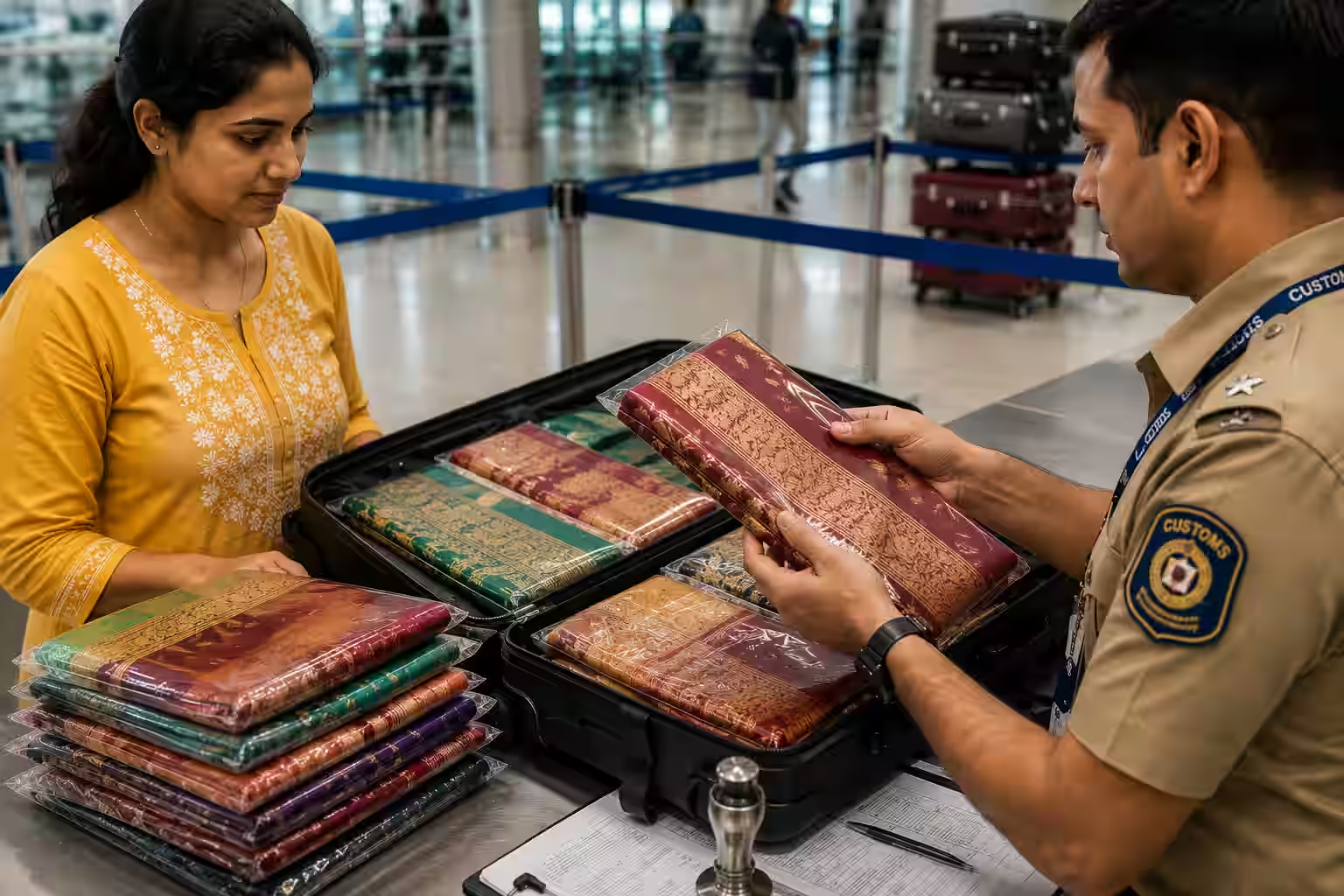
A saree is unstitched fabric, so it is classified by fibre, not by what it will be worn to. Silk woven fabric falls under HS heading 5007, and Indian export documentation classifies silk sarees specifically at 50072010. Cotton sarees classify in Chapter 52 and man-made-fibre sarees in Chapters 54 and 55, again by fibre. None of this is difficult, but it does mean the invoice needs to say what the fabric is: an officer reading "saree" alone cannot classify it, while "silk saree, 5.5m, hand-woven" needs no further thought.
- Describe the fibre — silk, cotton, silk-cotton blend, art silk — because the fibre drives the classification.
- State whether it is handloom or power loom where you know; handloom is a meaningful description, not decoration.
- Declare an honest value. A bridal Kanchipuram is genuinely worth what it costs, and under-declaring it wrecks any insurance claim.
- Mention zari content. Real zari carries metallic thread and its value should be reflected honestly.
- For a used or personal saree being sent home, say so — a worn personal garment is valued differently from new retail stock.
- Quantities matter. Several identical new sarees read as commercial stock rather than a personal gift.
| What you are sending | Classified by | Where it sits |
|---|---|---|
| Silk saree (Kanchipuram, Banarasi, Mysore) | Silk woven fabric | HS 5007 — 50072010 in India |
| Cotton or handloom cotton saree | Cotton woven fabric | Chapter 52, by construction |
| Art silk, georgette, polyester saree | Man-made fibre fabric | Chapters 54 / 55 |
| Silk-cotton or tissue blend | The dominant fibre by weight | Follows the majority fibre |
| Worn personal saree being sent home | Used personal effects | Declared as used, not new stock |
Blends follow the fibre that dominates by weight — say so on the invoice rather than leaving it to be guessed.
Write the description like this
"1 x silk saree, hand-woven Kanchipuram, 5.5m + 0.8m blouse piece, real zari border, personal gift, not for resale — value INR 24,000." Fibre, length, weave, zari, purpose, value. That single line answers every question an officer would otherwise open the box to ask.
Step 02
Duty, VAT and gift relief by destination
Textiles carry no special exemption anywhere. What changes by country is the threshold at which the receiver starts paying.
Duty and import tax are the receiver's liability almost everywhere, and sarees get no protected category the way original artworks do. The figures below move frequently — several major markets revised theirs in the last two years — so treat this as the shape of the rule and let us confirm the live position for your route at booking.
| Destination | Express transit | What the receiver pays |
|---|---|---|
| USA | 5-8 working days | De minimis suspended for all countries on 29 August 2025, so every parcel is a formal entry at any value. Duty is the rate for the heading plus the reciprocal tariff on Indian goods, cut from 50% to 18% on 2 February 2026. |
| UK | 4-7 working days | Genuine gifts between private individuals under £39 are free of VAT and duty. From £39 to £135, 20% VAT and no duty. Above £135, both apply. |
| EU | 4-7 working days | Import VAT from the first euro. From 1 July 2026 the EU removed its €150 duty exemption and applies a transitional flat duty of €3 per parcel. |
| Canada | 5-8 working days | Courier de minimis from India is only CAD 20 — far below the CUSMA thresholds. GST/HST applies above it. |
| Australia & NZ | 5-8 working days | GST applies on consignments above AUD 1,000; below that it is normally collected at the point of sale. |
| Singapore & Malaysia | 3-5 working days | GST on imported goods, applied above the local low-value threshold. |
| UAE & Gulf | 2-4 working days | The fastest and cheapest saree lane from India. VAT and duty apply above the local threshold. |
Thresholds and reliefs change often. ShipHit confirms the current position for your specific destination before dispatch rather than relying on a figure printed in a blog post.
The gift relief is narrower than people think
UK gift relief applies only between two private individuals. A boutique sending to a customer does not qualify at any value, and neither does a parcel a family member is paid for. Marking a commercial saree "gift" to duck £39 is the single most common declaration error on this lane, and it is the one that gets a consignment held.
Step 03
Never pack a saree with food
This is the single most common way a saree is ruined, and it has nothing to do with the courier.
Pickle oil migrates. Ghee migrates. A poorly sealed jar three items away in the same carton will find silk, and an oil stain on a zari border is permanent. Damp is the same story more slowly: any food with moisture in it raises the humidity inside a sealed carton over a week of transit, and silk holds that damp against itself.
If the same parcel is carrying pickles, podi or snacks, the packing rules for those are strict for exactly this reason, and we have set them out in our guide to Sending pickles masala spices guide which covers the double-seal method for oil.
- Sarees travel in their own sealed poly bag, inside their own inner box or a rigid layer of the carton.
- If the consignment carries food as well, it belongs at the opposite end of the box with its own double seal and absorbent material.
- Ideally, send textiles and food as separate consignments. It costs a little more and removes the risk entirely.
- Add a silica gel sachet inside the saree bag for humid destinations or monsoon-season dispatch.
- Never use newspaper against silk — the ink transfers. Use acid-free tissue or plain muslin.
- Keep camphor and naphthalene balls out of the bag. They stain silk and the smell survives the flight.
Step 04
Folding and packing so it arrives wearable
Silk remembers everything done to it. A fold held for two weeks becomes a line that does not come out.
The aim is to minimise the number of hard creases and to keep any fold away from the zari. A saree folded loosely along different lines from its shop fold, with tissue in the folds, arrives needing a press rather than a repair.
- Refold along different lines from the shop creases so the same fibres are not stressed twice.
- Lay acid-free tissue or plain cotton cloth into each fold, especially anywhere the zari border doubles over.
- Roll rather than fold where the box allows — a rolled saree has no hard creases at all.
- Keep the pallu and the zari border on the inside of the pack, protected by the body of the saree.
- Seal in a poly bag to keep damp out, then into a rigid box so nothing compresses it.
- Pack the blouse piece and fall flat alongside, not bunched into a corner where they emboss the silk.
- For a bridal or heavily worked saree, a rigid box rather than a poly mailer is not optional.
Roll, don't fold, wherever the box allows
A saree rolled around a soft core — a tube of tissue, or the saree's own fall — arrives with no hard crease anywhere on it. Rolling costs a slightly longer box and nothing else, and it is the single biggest difference between a saree that needs a press and one that needs a weaver.
Step 05
Sarees that need more than the standard pack
Not every saree behaves the same in a box. Five kinds need a decision made before it is sealed.
Most cotton and everyday silks travel well with the method above. The ones that go wrong are the ones with something on the surface — metal, stone, paint or a very open weave — because the damage is done by pressure rather than by handling.
Stitched blouses, lehengas and readymade apparel travelling in the same consignment are classified differently from unstitched saree fabric, and the export paperwork for a boutique differs again — both are covered in our guide to Garments guide which sets out the IEC, LUT and HSN requirements in full.
- Real zari (Kanchipuram, Banarasi): metallic thread work cracks along a hard fold and tarnishes against damp. Tissue in every fold, silica in the bag, rigid box.
- Tissue and organza: an open, springy weave that will not lie flat and will hold any crease it is compressed into. Roll these, never fold.
- Stone, bead and heavy embroidery work: the stones emboss the silk beneath them under stack pressure. Interleave a sheet of tissue or muslin between the worked panel and the fabric it presses against.
- Hand-painted Kalamkari and printed silks: pigment lifts when it is pressed against itself in heat. Interleave, and never bag them while there is any damp in the fabric.
- Antique or heirloom sarees: fragile at every existing fold line. Refold along fresh lines, pad each fold, and insure at a valuation rather than a guess.
Step 06
Wedding and bridal sarees: value, evidence and timing
A bridal saree is the highest-value single item most families ever ship, and the one with an immovable deadline.
Two things go wrong with bridal consignments, and both are avoidable. The first is a declared value chosen to reduce duty, which then caps the claim if anything happens. The second is booking against the ceremony date instead of against the ceremony date minus a customs examination.
Wedding consignments usually travel alongside return gifts and bulk parcels for the same event, and those have their own declaration and packing rules — see our guide to Wedding & return gifts guide before combining the two.
- Insure at the honest purchase value and keep the invoice — a claim is settled against the declared value, not the sentimental one.
- Photograph the saree fully unfolded before packing, including the zari border and pallu. That photograph is your evidence of condition on dispatch.
- Book with real margin. Aim to land two weeks before the ceremony, not two days — a saree that arrives the day after is a saree that did not arrive.
- Send bridal and trousseau sarees as their own consignment, not mixed with gifts, sweets or return-gift bulk.
- Give the receiver's phone number and a delivery window they can actually answer — a failed delivery on a wedding week is an expensive re-attempt.
Step 07
Door pickup and what it costs
Sarees are one of the few Indian parcels billed on actual weight rather than volume, which makes them cheaper to send than most people expect.
Most household categories are light and bulky, so they price on volumetric weight. Folded textiles are the opposite — dense and compact — so a saree consignment usually bills on real weight. Two or three sarees in a right-sized rigid box is an efficient parcel, and adding a fourth changes the cost far less than people assume.
Because textiles behave differently from most parcels on price, it is worth understanding how the two weights are compared before choosing a box — the formula is in our guide to Actual vs volumetric weight pricing guide with worked examples.
Most saree consignments are collected across the weaving belt and routed through our Send sarees from Chennai with Coimbatore, Tiruppur, Pondicherry and Mayiladuthurai covering the surrounding districts.
If the parcel is also carrying home-cooked food for the family, keep the two in separate inner packaging and read our International food shipping guide for what is allowed at the destination.
- A single saree weighs roughly 500g to 900g; a Kanchipuram with heavy zari can reach 1.2kg on its own.
- Send several together. The cost per saree falls sharply after the first, because the base charge is already paid.
- Right-size the box. An oversized carton is the one way a saree parcel flips onto volumetric weight and stops being cheap.
- Pickup is from home, the shop or the weaver, so nothing has to be carried to a depot.
- The team checks the fold, adds tissue where the zari needs it and boxes the saree on site.
- Tracking runs door to door, and the parcel is insurable at declared value from collection.
Frequently Asked Questions
Can I send a saree abroad by international courier from India?
Yes, and textiles are among the more straightforward categories. The invoice needs to describe the fabric rather than the occasion — silk, cotton or blend, length, and handloom or power loom — along with an honest declared value. Duty and tax are the receiver's and depend on the destination.
What is the HS code for a silk saree?
Silk woven fabric falls under HS heading 5007, and Indian export documentation classifies silk sarees specifically at 50072010. Cotton sarees classify in Chapter 52 and man-made-fibre sarees in Chapters 54 and 55, by fibre. ShipHit prepares the classification as part of the commercial invoice.
How much does it cost to courier a saree abroad from India?
Less than most people expect, because folded textiles are dense and compact, so a saree parcel usually bills on actual weight rather than volumetric weight — the opposite of most household categories. A single saree runs roughly 500g to 900g, and adding a second or third to the same box costs far less than sending them separately.
Do I have to pay customs duty on a saree sent abroad?
The receiver does, and it depends on the destination. Sarees carry no special exemption anywhere. The USA suspended de minimis for all countries on 29 August 2025, so every consignment is a formal entry at any value. The UK allows genuine gifts between private individuals under £39 free of VAT and duty. Canada's courier de minimis from India is only CAD 20.
Can I send a saree and food in the same parcel?
You can, but it is the commonest way a saree is ruined. Oil from a pickle jar and moisture from any wet food will reach the silk over a week in a sealed carton, and an oil stain on zari is permanent. If both must travel together, the saree goes in its own sealed bag at the opposite end of the box. Separate consignments are safer.
How should a saree be folded for shipping?
Refold along different lines from the shop creases, lay acid-free tissue into every fold, and keep the zari border and pallu on the inside protected by the body of the fabric. Rolling is better than folding where the box allows, because it creates no hard creases at all. Never use newspaper — the ink transfers.
How do I ship a Kanchipuram silk saree without damaging the zari?
Real zari is metallic thread and cracks along any fold held under pressure, so keep every fold away from the border, pad the folds with acid-free tissue, and use a rigid box rather than a poly mailer. Add a silica gel sachet against damp, which tarnishes zari, and keep camphor out of the bag entirely.
Should I insure a wedding saree?
Yes. A bridal saree is often the highest-value item a family ships, and the declared value is what a claim is settled against. Insure honestly, keep the purchase invoice, and photograph the saree unfolded before packing as evidence of its condition on dispatch.
How long does a saree take to reach the USA or UK?
Around 5-8 working days to the USA and 4-7 to the UK and Europe, door to door, before any customs examination. Canada runs 5-8, Australia 5-8, Singapore 3-5 and the UAE 2-4. For a wedding, book with real margin rather than counting on the fastest possible transit.
Can I send used or old sarees to family abroad?
Yes. Declare them as used personal effects rather than new goods — a worn personal saree is valued differently from retail stock, and describing it honestly usually clears faster than dressing it up. Launder before packing, and keep the quantity clearly personal rather than commercial.
Can a boutique or weaver send sarees abroad commercially?
Yes, but commercial export needs IEC registration, a GST-compliant invoice, an LUT to avoid paying IGST upfront and an 8-digit HSN code. Those requirements are set out in full in our guide to international courier for garments from India. Personal and gift parcels need none of it.
Can ShipHit collect the saree from the shop or weaver?
Yes. Collection can be arranged from your home, the retailer or the weaver directly, and the team checks the fold, adds tissue where the zari needs protecting and boxes it on site, so an unpacked saree never travels to a depot.
Related shipping guides
More routes and guides not mentioned above.